
MACROECONOMICS
Up


Table of Contents

UNEMPLOYMENT

INFLATION 

THE CIRCULAR FLOW

NATIONAL INCOME ACCOUNTING

ECONOMICS GROWTH

ECONOMIC DEVELOPMENT


Unemployment


I. Unemployment: the number of adults (16 years or older) who are willing and able to work and who are actively looking for work but have not found a job.


II. Historical Unemployment Rates: The proportion of the labor force that is unemployed. The labor force is the number of persons 16 years of age or older who have jobs plus the number who are looking and available for jobs.


III. Employment, Unemployment and the Labor Force: All persons 16 years of age and over can be classified as not in the labor force (i.e. homemakers, and those in school), employed, or unemployed. Then the employed are subtracted from the labor force to get the unemployed. The unemployment rate is the number of unemployed divided by the labor force times 100.

A) Categories of Those Without Work

1. Job Loser: involuntarily terminated or laid off (40–60% of unemployed)

2. Reentrant: worked full-time before but who left the labor force (20–30% of unemployed)

3. Job Leaver: voluntarily ended employment (10–15% of unemployed)

4. New Entrant: has never worked at a full-time job for more than two weeks or more (10–13% of unemployed)

B) Duration of Unemployment: The duration of unemployment is inversely related to the overall level of economic activity. The average duration of unemployment is 3.4 months.


C) The Discouraged Worker Phenomenon: Individuals who have stopped looking for jobs because they do not believe that they can find one are called discouraged workers.


D) Labor Force Participation: This is the proportion of working age persons who are in the labor force. The statistic can be computed for any group.

 IV. The Major Types of Unemployment:

A) Frictional Unemployment: Unemployment due to the fact that workers must search for appropriate job offer. This takes time, so they remain temporarily unemployed.


B) Structural Unemployment: Unemployment resulting from a poor match of workers’ skills and abilities with current requirements of employers. It also includes persons who are unemployed because of labor-market policies by government that make it expensive to employ workers (e.g. social insurance programs) and to fire them or lay them off by closing plants.


C) Cyclical Unemployment: Unemployment resulting from recessions.


D) Seasonal Unemployment: Unemployment resulting from the seasonal pattern of work in specific industries due to weather or demand patterns. The official reported unemployment rate reported each month is seasonally adjusted and thus reflects only the sum of frictional, structural, and cyclical unemployment.

V. Full Employment: Economists use the concept of the natural unemployment rate which is an unemployment rate that uses only frictional and structural unemployment as a measure of full employment. It is estimated to be an unemployment rate of roughly 5% today.


| Return to Top |


Inflation


I. Inflation: The situation in which the average of all prices of goods and services in an economy is rising. Deflation is a situation in which the average of all prices in an economy is falling.


II. Inflation and the Purchasing Power of Money: The value of a person’s money income in buying goods and services is its purchasing power or the real value of the money. The price of anything expressed in today’s dollars. The purchasing power of money varies inversely with the price level.


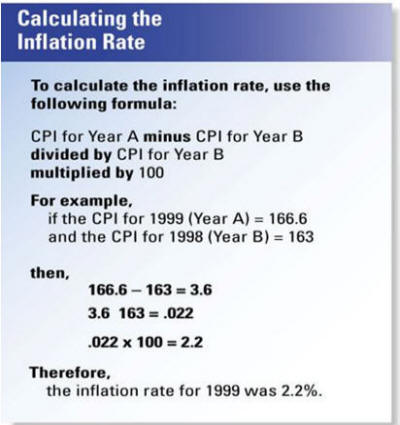
III. Measuring the Rate of Inflation: Inflation is measured by a price index.

A) Computing a Price Index: A fixed quantity price index is the cost of today’s market basket of goods expressed as a percentage of the cost of the same market basket in a base year. It is computed by dividing the cost of today’s market basket by the cost of that same market basket in the base year times 100.


B) Real World Price Indexes

1. The CPI: a weighted average of a specified set of goods and services purchased by consumers in urban areas

2. PPI: A statistical measure of a weighted average of prices of goods and services that firms produce and sell

3. GDP Deflator: a price index that measures the changes in prices of all new final goods and services produced in the economy

IV. Anticipated Versus Unanticipated Inflation: Unanticipated inflation is inflation that comes as a surprise. Anticipated inflation is the inflation rate that we believe will occur and can be either higher or lower than the actual rate.


V. Inflation and Interest Rates: The nominal interest rate is the market rate of interest. The real rate of interest is the nominal rate minus the anticipated rate of inflation. Evidence shows that inflation rates and nominal interest rates move together.


VI. Does Inflation Necessarily Hurt Everyone?

A) Unanticipated Positive Inflation: Creditors Lose and Debtors Gain: Creditors lose because the debtor is charged an interest rate that does not cover the actual inflation rate. If unanticipated inflation is greater than actual inflation, creditors gain and debtors lose.


B) Protecting Against Inflation: Banks and other lenders raise interest rates to protect themselves from anticipated inflation. Workers seek cost-of-living adjustments, i.e., automatic increases in wage rates to offset inflation.


C) The Resource Cost of Inflation: Businesses and individuals use resources to protect themselves from inflation, e.g. re-pricing goods and service. The resources could have been used to produce additional goods and services.

VII. Changing Inflation and Unemployment: Business Fluctuations: These are the ups (expansions) and downs (contractions) in business activity throughout the economy. A recession is a contraction or downturn in the level of business activity.

A) Explaining the Business Fluctuations: External Shocks: While many downturns in economic activity have been caused by external shocks to the economy, e.g. war, changes in oil prices, and weather, many others have occurred without any external shock.

| Return to Top |


The Circular Flow


The concept of a circular flow of income involves two principles; (1) in every economic exchange, the seller receives exactly the same amount that the buyer spends and (2) goods and services flow in one direction and money payments flow in the other.

A) Profits Explained: Profits are a part of costs because entrepreneurs must be rewarded for providing their services, or they will not provide them.


B) Total Income or Total Output: Total income is the total of all individuals’ income and is also defined as the annual cost of producing the entire output of final goods and services. Total output is the value of all of the final goods and services produced in the economy during the year.

1. Product Markets: households are the buyers and businesses are the sellers of consumer goods

2. Factor Markets: households are the sellers; they sell resources such as labor, land, capital, and entrepreneurial ability

C) Why the Dollar Value of Total Output Value Must Equal Total Income: Total income is income earned by households in payment for the production of these goods and services. The value of total output is identical to total income, since spending by one group is income to another.

DIAGRAM OF THE CIRCULAR FLOW OF THE ECONOMY

FREE ENTERPRISE, THE ECONOMY & MONETARY POLICY

| Return to Top |


National Income Accounting


I. A measurement system used to estimate national income and its components.

A) Gross Domestic Product (GDP): The total market value of all final goods and services produced by factors of production located within a nation’s borders in a year. GDP is a flow, i.e., an activity that occurs over time. Contrast this with a stock measured at a point in time.


B) Exclusion of Financial Transactions, Secondhand Goods, and Transfer Payments: Many transactions occur that have nothing to do with final goods and services produced.

1. Financial Transactions: There are three categories of purely financial transactions.

a. Securities: The value of brokers’ services is included in GDP when an investor buys or sells securities because they perform a service.

b. Government Transfer Payments: Transfer payments are payments for which no productive services are concurrently provided in exchange.

c. Private Transfer Payments: This is a private transfer of funds from one person to another and these are not included in GDP.

C) Other Excluded Transactions

1. Household Production: Tasks performed by homemakers within their households for which they are not paid through the marketplace.

2. Otherwise Legal Underground Transactions: Legal transactions that are not reported and not taxed.

Illegal Underground Activities: These activities include prostitution, illegal gambling, and sale of illegal drugs, etc.

D) Recognizing GDP’s Limitations: GDP is a measure of production and an indicator of economic activity. It is not a measure of a nation’s welfare. It excludes non-market activity and says little about our environmental quality of life.

II. Two Main Methods of Measuring GDP: The expenditure approach is a way of adding up the dollar value at current market prices of all final goods and services. The income approach could also be used, by adding up the income received by everybody producing final goods and products.

A) Deriving GDP by the Expenditure Approach: The components of total expenditures are added together.

1. Consumption Expenditures (C): Consumption expenditures fall into three categories; durable consumer goods, non-durable goods, and services.

2. Gross Private Domestic Investment (I): When economists refer to investment, they are referring to expenditures that represent an addition to our future productive capacity. Investment consists of fixed investment, changes in inventories, and consumer expenditures on new residential structures.

3. Fixed Versus Inventory Investment: Fixed investment is the purchase of capital goods which increase productive capacity in the future. Inventory investment represents net additions to the stock of goods that can be consumed in the future.

4. Government Expenditures (G): The government buys goods and services from private firms and pays wages and salaries to government employees. Since many government goods are not sold in the market place, we value them at their cost.

5. Net Exports (Foreign Expenditures): Net exports (X) are equal to total exports minus total imports.

B) Deriving GDP by the Income Approach: The second approach to calculating GDP is the income approach, which looks at total factor payments. Total income is all income earned by the owners (or resources) who put their factors of production to work. Using this approach gross domestic income or GDI is computed and GDI is identically equal to GDP.

1. Wages: Wages, salaries, and other forms of labor income, such as income in kind and incentive payments. Social Security taxes paid by both the employees and employers are also counted.

2. Interest: Only interest received by households plus net interest paid to us by foreigners is included.

3. Rent: Income earned by individuals for the use of their real (non-monetary) assets, such as farms and houses.

4. Profits: Total corporate profits plus proprietors’ income, i.e. income earned from the operation of unincorporated businesses, which include sole proprietorships, partnerships, and producers’ cooperatives.

5. Indirect Business Taxes: All business taxes except the tax on corporate profits. Indirect business taxes include sales and business property taxes.

6. Depreciation and Net Domestic Product: Depreciation must be added to Net Domestic Income to get Gross Domestic Income. Depreciation can be thought of as the portion of the current year’s GDP that is used to replace physical capital consumed in the process of production. Since somebody has paid for the replacement, depreciation must be added as a component of gross domestic income. Net Domestic Product (NDP) is GDP minus depreciation.

C) Other Components of National Income Accounting

1. National Income (NI): National Income is the total of all factor payments to resource owners and is obtained by subtracting indirect business taxes from NDP.

2. Personal Income (PI): Personal Income (PI) is the amount of income that households actually receive before they pay personal income taxes.

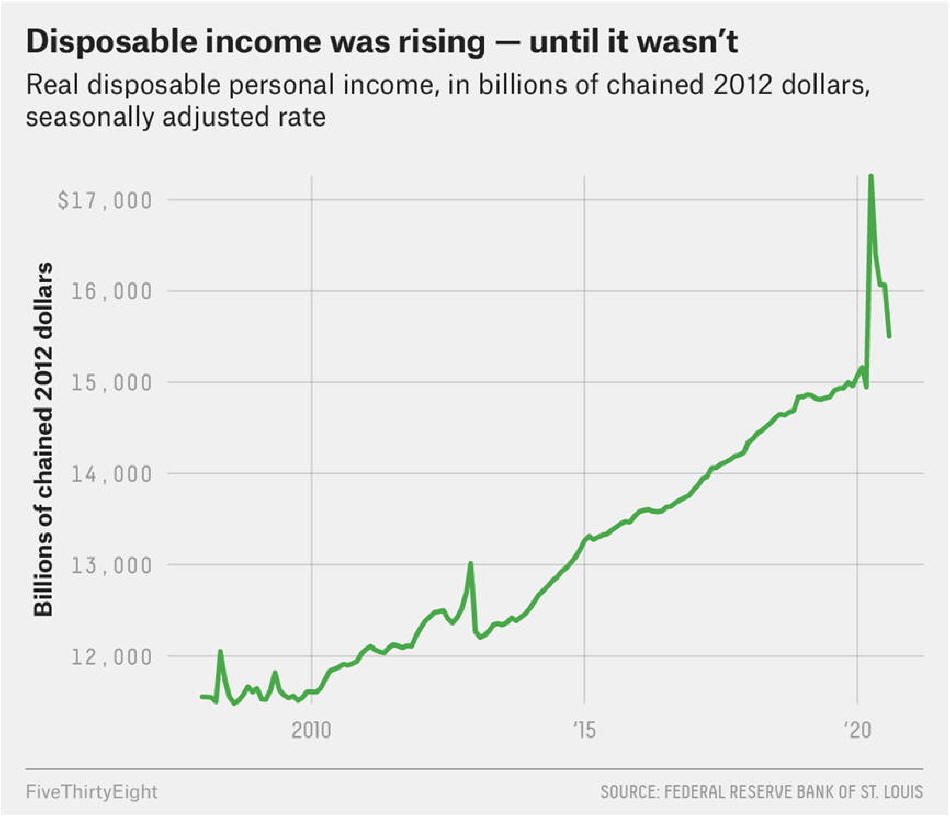
3. Disposable Personal Income (DPI): DPI is personal income after personal income taxes have been paid.

III. Distinguishing Between Real and Nominal Values: Nominal values are the values of variables such as GDP and investment expressed in current dollars (actual market prices), also called money values. Real values measure economic values after adjustments have been made for changes in the average of prices between years.

A) Correcting GDP for Price Changes: A price index that approximates the changes in overall prices is divided into the value of GDP in current dollars to adjust the value of GDP to what is called constant dollars. Constant dollars are dollars expressed in terms of purchasing power using a base year or standard of comparison. Price-corrected GDP is called real GDP.


B) Per Capita GDP: This is the calculation of the amount of GDP per person. Compute real GDP and divide by the total population.

IV. Comparing GDP Throughout the World: It is easy to compare living standards of families living in the same country because they use the same currency. When we compare families in different countries, there is a problem with different currencies and cost of living differences.

A) Foreign Exchange Rates: A foreign exchange rate is the price of one currency in terms of another. Thus if one franc costs 20 cents and French per capita income is 100,000 francs per year, then French per capita dollar income is $20,000 per year. GDP can be calculated the same way.


B) True Purchasing Power: Using purchasing power parity, an adjustment is made in exchange rate conversions that takes into account the true cost of living across countries.


How Much Is That Worth Today?


Measuring Worth


ECONOMIC INDICATORS: BY THE NUMBERS


ECONOMIC INDICATORS: WHAT THEY ARE & WHY THEY'RE IMPORTANT (flash)


CONSUMER PRICE INDEX

| Return to Top |


Economic Growth


I. How do we define economic growth? Increases in per capita real GDP over time. It is measured by the rate of change of real GDP per capita per year. If there is economic growth, the production possibilities curve will shift outward.MIKE KEEFE 04/04/2008

A) Problems in Definition: Real standards of living can go up without any positive economic growth when individuals are, on average, enjoying more leisure by working fewer hours, but producing as much as before. Growth tells us nothing about the distribution of output and income.


B) Is economic growth bad? Anti-growth proponents suggest that economic growth is bad because it raises expectations faster than income. Our measures of growth allow us to make comparisons across countries and time and provide a serviceable measure of productivity.

II. Productivity Increases: The Heart of Economic Growth: Labor productivity is real GDP divided by the number of workers (output per worker). Increases in labor productivity lead to increases in the standard of living. If all resources are divided up into labor and capital, then the growth of per capita GDP is the cumulative contribution of the growth of capital, the growth of labor, and the rate of growth of capital and labor productivity.


III. Saving: A Fundamental Determinant of the Rate of Economic Growth: Higher savings rates lead to higher living standards in the long run, other things equal, because investment and the capital stock will increase.


IV. New Growth Theory and the Determinants of Growth: New Growth Theory examines factors that determine why technology, research, innovation, and the like are undertaken and how they interact.

A) Growth in Technology: The growth of the power of the personal computer is given as an example of technological change.

1. Technology: A Separate Factor of Production: One of the major foundations of new growth theory is that the greater the rewards, the more technological advances we will get.

2. Research and Development: Technological advance can come from R&D that develops new materials, products, and processes. Thus, some technological advance depends on the rate of spending on R&D and business spending on R&D depends on expected profits. The greater the reward, the more technological advances we will get.

3. Patents: A 20–year monopoly on a new product or technique granted by the federal government to an inventor.

4. Positive Externalities and R&D: Some of the results of R&D spending accrue to others who benefit without paying. An estimated 25 percent of R&D spending in the top 7 industrialized countries accrues to foreigners.

B) The Open Economy and Economic Growth: Open economies can experience higher rates of growth than closed economies, because free trade encourages a more rapid spread of technology and industrial ideas and may give domestic industries access to a bigger market.


C) Innovation and Knowledge: Innovation involves transforming an invention into something that benefits the economy. Much innovation involves small improvements in the use of an existing technology.

1. The Importance of Ideas and Knowledge: Past investment in capital may make it more profitable to acquire more knowledge. There exists the possibility of an investment-knowledge cycle where investment spurs knowledge and knowledge spurs investment. Therefore knowledge, like capital, has to be paid for by forgoing current consumption. Knowledge can be viewed as a store of ideas. Thus, economic growth can continue as long as we keep coming up with new ideas.

2. The Importance of Human Capital: Increases in the productivity of the labor force are a function of increases in human capital. Human capital is at least as important as physical capital.

D) Population and Immigration as They Affect Economic Growth: Population growth implies that more workers are entering the labor force, which the evidence shows can increase technological progress, which increases the rate of economic growth.

V. Property Rights and Entrepreneurship: The more certain private property rights are, the more capital accumulation there will be. If people have property rights in their wealth that are sanctioned and enforced by the government, they will save and invest more.

INNOVATION, TECHNOLOGICAL CHANGE & THE ECONOMY

| Return to Top |


Economic Development


The essential issue of development economics is why some countries grow and develop and others do not and the policies that might help developing countries get richer.

A) Putting World Poverty into Perspective: At least one-third of the world’s population lives at subsistence level. The official poverty level in the United States exceeds the average income of at least one-half of the world’s population.


B) The Relationship Between Population and Economic Development: World population is expected to reach approximately 9.3 billion by the year 2050, up from 7 billion today. Excessive population growth has been a concern ever since Malthus’ day (1798).

1. Malthus Was Proved Wrong: As population has grown, the amount of food produced as measured by calories per person has increased. Also, the relative price of food has fallen for more than a century.

2. Growth Leads to Smaller Families: As nations get richer, the average family size declines.

C) The Stages of Development: Agriculture to Industry to Services: Modern rich nations went through three stages as they developed. From the dominance of agriculture to that of manufacturing and finally to the dominance of services. It is important that nations that wish to develop specialize in those products in which they have comparative advantage.


D) Keys to Economic Development

1. An Educated Population: Developing countries can advance more rapidly if they invest more heavily in secondary education.

2. Establishing a System of Property Rights: The more certain property rights are, the more capital accumulation and economic growth there will be, other things being equal.

3. Letting “Creative Destruction” Take Its Course: “Creative destruction” occurs when new businesses ultimately create new jobs and economic growth after first destroying old jobs, old companies, and old industries.

4. Limiting Protectionism: Open economies experience faster economic development than do economies that are closed to international trade.

| Return to Top |


Copyright © 1996 Amy S. Glenn
Last updated: 03 February 2012