|
 Site Search
and Site Map
Site Search
and Site Map
Table of Contents
Sectors and Functions
1.
Household
sector: all people seeking to satisfy unlimited wants and needs … responsible for
consumption
2.
Business sector:
those combining resources to produce goods and services … responsible for the
production.
3.
Government
sector: federal, state and local governments … responsible for regulation,
pass laws, collect taxes and force other economic sectors to do things that they
wouldn't do voluntary
4.
Foreign sector:
everyone and everything beyond the boundaries of the domestic economy
Sector Expenditures
-
Household consumption
of final goods and services
a.
Nondurable goods lasting
less than a year
b.
Durable goods lasting more
than a year
c.
Services / Intangible activities
-
Business investment
in final goods and services, mainly capital goods … most volatile of the four
expenditures
a.
Fixed structures: buildings,
factories, housing
b.
Equipment: machinery and
tools
c.
Inventories: raw materials
and unsold goods
-
Government purchases
of final goods and services produced by the economy … does not include transfer
payments
-
Foreign net
exports: exports (purchases of domestic production by everyone who is
not a citizen of the domestic economy) minus imports (purchases of foreign production
by the domestic economy)
Markets
1.
Product markets: The combination of all markets in the economy that
exchange final goods and services. These markets are the mechanism that exchanges
gross domestic product. These are also called the aggregate market.
2.
Resource markets:
These markets exchange the services of the economy's resources, or factors of production
— labor, capital, land and entrepreneurship. These are also called factor markets.
3.
Financial
markets: These are markets that trade financial instruments like stocks and bonds.
They play an important role in capital investment.
Flows
1.
Physical flow: the physical movement of goods and services
2.
Payment flow: the movement of money payments from the household to
the business sector in exchange for final goods and services and from the business
to the household sector in exchange for the services of resources

The circular flow is a model of the continuous production
and consumption interaction among the four major sectors that takes place through
the three aggregated markets.
Household and Business
Sectors
The physical flow is the flow of resources from
the household to business sector and production from the business to the household
sector:
o Production flows from the business
sector (supply) to the household sector (demand) through product markets.
o Resources flow from the household
sector (demand) to the business (supply) sector through resource markets.
o The household sector sells resources
through resource markets and buy goods through the product markets.
o The business sector buys resources
through the resource markets and sells goods through the product markets.
The payment flow goes in the opposite
direction of the physical flow:
o The household sector buys production
from the business sector in exchange for payment through product markets.
o The business sector buys resources
from the household sector in exchange for payment through resource markets.
o Revenue received by the business sector
for selling goods is used to pay the resources of production.
o Factor payments become income used
by household sector to buy production from the business sector.
Financial markets divert income from household
consumption to business investment. Saving is not consumption … it does not disappear,
it is income diverted away from the consumption flow and supplied, or loaned, to
the financial markets.
Government Sector
The government sector plays a key role in the economy
and the circular flow with government spending and taxes.
o Government spending is divided into
government purchases and transfer payments.
o Government purchases include: national
defense, roads, educational system, post offices, fire and police protection,
parks, sewage treatment plants, etc.
o Taxes are used to divert household
sector income to the government sector to pay for these purchases.
o When government does not collect enough
taxes to pay for purchases, it borrows through the financial markets.
o The diversion of income into taxes
used to purchase government production shows up in the circular flow model.
Foreign Sector
The foreign sector is made up of households, businesses
and governments outside the domestic economy. Market exchanges are a natural means
of addressing the scarcity problem. Mutually beneficial exchanges aren't limited
by geographic location or political boundaries. Foreign trade, the exchange among
buyers and sellers in different nations, is an extension of mutually beneficial
exchanges among people of the same country.
o Exports are goods and services produced
by the domestic economy and purchased by the foreign sector.
o Imports are goods and services produced
by the foreign sector and purchased by the domestic economy.
o Exports flow from the foreign sector
and join GDP before reaching the business sector.
o Imports flow away from the consumption,
investment and government purchases streams and go to the foreign sector.
Total spending doesn’t always match total
output at the desired full-employment–price-stability level. The circular flow of
income illustrates how this undesirable outcome happens and how it might be resolved.
A leakage
is income not spent directly on domestic output, but instead diverted from the
circular flow. Saving is a primary leakage from the circular flow. It represents
income not directly returned to the product markets. Imports and taxes represent
leakage from the circular flow. Business saving is also a leakage from the circular
flow of income.
Injections
of investment, government spending and exports help offset leakages from saving,
imports and taxes. An injection is an addition of spending to the circular
flow of income.
The Gross Domestic Product equals the
total market value of all final goods and services produced in the economy in a
given period of time, usually one year. A larger GDP means that we have more goods
and services to satisfy our unlimited wants and needs. The four sectors of the economy
buy ALL current economic production and those aggregated sectors give us GDP.
The four sectors and their expenditures:
-
Household: Consumption
(C).
-
Business: Investment
(I).
-
Government: Government
Expenditures (G).
-
Foreign: Net Exports
(X), the difference between exports and imports
Expenditures on GDP:
GDP = C + I + G + X
o C, I and G buy not just domestic goods
and services, but also imports.
o When we aggregate C, I, G and X we
have domestic production plus net exports. To measure only domestic production,
we subtract imports.
Economic Goals:
o Full employment: using all available resources for production
o Stability: avoiding inflation and/or fluctuations in the economy
o Growth: lessening the problem of scarcity by increasing production capabilities …
an outward shift in the PPC
The macro economy is unstable. It has
periods of falling production, rising inflation and/or high unemployment.
Business
cycles are recurring expansions and contractions of the aggregate economy.
o Expansion
is a general period of increasing economic activity, or rising production, which
is associated with low or falling unemployment and high or rising inflation.
o Contraction
is a general period of decreasing economic activity, or falling production,
which is associated with high or rising unemployment and low or falling inflation.
Causes of Instability
-
Consumption:
If households decide to buy more or less, the rest of the economy follows suit.
Aggregate demand (see below) is the prime source of economic instability.
-
Capital
Investment: Big swings in investment levels can create upward or downward
spirals of total production.
-
Government
Purchases and Taxes: Government purchases can have a contractionary
or an expansionary effect over the economy. Taxes affect the ability of the
household and business sectors to buy production.
-
Net
Exports: Changes in exports can trigger expansions and contractions of
the domestic economy.
-
Circulating
Money: Too much money can trigger an inflationary expansion, too little
money can trigger contraction and unemployment.
-
Resource
Supply Considerations: Resource supply changes (energy prices,
technology, wages, etc.) can trigger expansions and contractions.
The aggregate market (AD/AS analysis)
is the key model used to explain and analyze the workings of the macro economy.
The aggregate market operates through:
o aggregate demand (expenditure)
o aggregate supply (production)
o price level
Aggregate Demand
Aggregate demand is the total quantity
of output demanded at alternative price levels in a given time period, ceteris paribus.
It refers to the collective behavior of
all buyers in the marketplace.
-
Household consumption
on final goods and services (66% of total spending)
-
Nondurable goods
lasting less than a year
-
Durable goods lasting
more than a year
-
Services / Intangible
activities
-
Business investment
in final goods and services, mainly capital goods … most volatile of the four
expenditures
-
Fixed structures: buildings, factories, housing
-
Equipment: machinery
and tools
-
Inventories: raw
materials and unsold goods
-
Government purchases
of final goods and services produced by the economy … does not include transfer
payments
-
Foreign net exports: exports (purchases of domestic production by everyone who is not a citizen
of the domestic economy) minus imports (purchases of foreign production by the
domestic economy)
Aggregate demand shows the relationship between
total expenditures (measured as real GDP) and the price level (measured as the GDP
price deflator) — How much will be purchased at various price levels?
The aggregate demand
curve shows the aggregate demand for various price levels. The AD
curve has a negative slope — from top left to bottom right — because sectors are
inclined to increase their aggregate spending if the price level decreases and decrease
spending if the price level increases.
Negative slope due to:
real-balance effect: a change in price level changes aggregate expenditures on real production because
the purchasing power of money changes
interest-rate effect: a higher price level leads to a higher interest rate which increases the cost
of borrowing and discourages investment and consumption … and vice versa
net-export effect:
an increase in the US price level discourages foreign buyers from buying US goods,
and encourages US buyers to buy relatively cheaper foreign goods … and vice versa
Aggregate Supply
Aggregate supply is the total quantity
of output producers are willing and able to supply at alternative price levels in
a given time period, ceteris paribus.
-
Labor: the people
who work
-
Capital: tools and
equipment used by producers
-
Land: raw materials
used in production
-
Entrepreneurship:
those who assume the risk of production
The aggregate supply curve
shows the relation between total real production (measured as real GDP) and
the price level (measured as the GDP price deflator) — How much will be produced
at various price levels?
We study aggregate supply over two time
periods: the short run and the long run. How the price level affects real production
depends on the difference between the short run and long run.
-
Long run
-
period in which
all prices are flexible so that that all markets (product, resource, financial)
are in equilibrium
-
prices rise to
eliminate market shortages and fall to eliminate market surpluses, resulting
in equilibrium
-
price level does
not affect the aggregate supply of real production
-
the LRAS curve
is a straight, vertical line ... equilibrium with all resources fully employed
-
Short run
-
period in which
some prices are flexible and some are rigid
-
rigid prices prevent
markets (especially resource and labor) from eliminating surpluses and reaching
equilibrium, e.g. unemployment
-
the price level
does affect the aggregate supply of production
-
the SRAS curve
is a positively-sloped line ... higher price levels correspond to higher levels
of real production
Aggregate Market
The aggregate market (AD/AS analysis)
combines aggregate demand and aggregate supply as a way of understanding the macro
economy, especially the problems of inflation and unemployment.
o The aggregate demand force is the
four sectors who want GDP at the lowest price level possible.
o The aggregate supply force is the
scarce resources who want to sell GDP at the highest prices possible.
o Equilibrium in the aggregate market
occurs when the forces of aggregate demand and aggregate supply are balanced.
o A market is in equilibrium when buyers
and sellers come upon a price that generates the same quantity demanded and
quantity supplied.
o Long-run equilibrium: All three aggregate
markets (product, resource, financial) achieve equilibrium simultaneously.
o Short-run equilibrium: Price and wage
rigidity prevent equilibrium in the resource markets, even though the product
and financial markets are in equilibrium.
Classical Theory
Prices and wages are flexible.
The economy “self-adjusts” to deviations
from its long-term growth trend.
Say’s Law: supply creates its own
demand
Unsold goods and unemployed labor
disappear as soon as people have time to adjust prices and wages.
Keynesian Theory
A market-driven economy is inherently
unstable and requires government intervention.
Changes in aggregate demand (or aggregate
expenditures) especially investment expenditures are the primary source of business-cycle
instability and the most important cause of recessions.
Effective Demand: the principle that
consumption expenditures are based on the disposable income (personal income
after personal taxes) actually available to the household sector rather than
income that would be available at full employment. (consumption function)
Variables in addition to the interest
rate influence saving and investment: household saving is based on household
income and business investment is based on the expected profitability of production.
(investment function)
Prices are inflexible or rigid, especially
in the downward direction. and can prevent markets from achieving equilibrium.
Markets, especially resource markets,
do not automatically achieve equilibrium, meaning full employment is not guaranteed.
Persistent unemployment problems are
caused by a lack of aggregate demand.
Full employment is maintained through
government intervention, especially fiscal policy changes in government purchases.
Discretionary government policies,
especially fiscal policy, are the primary means of stabilizing business cycles.
AE = C + I + G + X
Household Sector
consumption function: the relationship
between planned consumption and various levels of disposable income
autonomous consumption: Household consumption
expenditures that are unrelated to and unaffected by the level of income … minimum
level of consumption the household sector undertakes if income falls to zero
induced consumption: consumption
expenditures that are based on the level of disposable income
marginal propensity to consume: only a portion
of additional income is used for consumption … MPC is the proportion of each
additional dollar of household income that is used for consumption expenditures,
what the household section does with additional income … MPC = ∆ consumption
/ ∆ disposable income (MPC + MPS = 1)
saving function: the difference between
income and consumption
dissaving: negative saving that occurs during
a given period of time in which consumption expenditures exceed income … only
possible by spending past or future income on current consumption, using income
saved from previous periods or borrowing income to be earned in future periods
induced saving: saving based on the
level of disposable income
marginal propensity to save: only a portion of
additional income is used for saving … MPS is the proportion of each additional
dollar of household income that is used for saving, what the household section
does with additional income … MPS = ∆ saving / ∆ disposable income (MPC + MPS
= 1)
multiplier: A measure of the interaction
between consumption, production, resource payments and income that magnifies autonomous
changes in investment, government spending, exports, taxes or etc. Relatively small
changes in autonomous expenditures cause relatively large overall changes in aggregate
production and income.
MPC + MPS = 1
Multiplier = 1 / (1—MPC)
OR 1 / MPS
Multiplier X ∆ autonomous spending (consumption)
= ∆ equilibrium GDP
Business Sector
investment function: the relationship between planned
investment (expenditures on (production of) new plant, equipment, and structures
(capital) in a given time period, plus changes in business inventories) and various
levels of interest rates. An increase in investment spending shifts the aggregate
demand curve to the right.
autonomous investment: changes in investment
expenditures by the business sector that are unrelated to income … influenced by
factors such as interest rates, technology, expectations and wealth
marginal propensity to invest: indicates the extent
to which investment expenditures are induced by changes in income or production.
If, for example, the MPI is 01, then each dollar of extra income in the economy
induces 10 cents of investment expenditures … MPI = ∆ investment / ∆ disposable
income
Government Sector
Discretionary Fiscal Policy: The discretionary
changing of government expenditures and/or taxes in order to achieve national economic
goals, such as high employment with price stability. If consumption and investment
spending decline, the subsequent decline in state-local government spending aggravates
the leftward shift of the AD curve.
A fiscal stimulus is tax cuts or spending hikes
intended to increase (shift) aggregate demand.
Fiscal restraint
is using tax hikes or spending cuts intended to reduce (shift) aggregate
demand.
Obstacles
Indirect Crowding Out
The Ricardian Equivalence Theorem
Direct Expenditure Offsets
The Supply-Side Effects of Changes in
Taxes
Time Lags
Foreign Sector
The principal role played by the foreign sector in
the circular flow is two-fold: (1) to add to the supply of output flowing into the
product markets that can be purchased by the three domestic sectors (imports) and
(2) to purchase part of the output supplied to the product markets by the domestic
economy (exports). If exports exceed imports, then the overall flow increases. If
imports exceed exports, then the overall flow decreases. Net exports can be both
uncertain and unstable, creating further shifts of aggregate demand.
COMPARISON OF ECONOMIC THEORIES
|
|
Classical
|
Keynesian
|
Monetarist
|
|
Labor
Market
|
Labor demand and labor supply are brought into equilibrium
by the real wage. As a result there is no involuntary unemployment.
|
Workers and firms bargain for a money wage, not for
a real wage. Money wages adjust slowly and workers resist any drop
in the money wage.
|
While not putting forward his own theory of the labor
market, Friedman argues that people do tend to think in "real" terms
and not in nominal amounts.
|
|
Financial
Market
|
Saving and Investment are brought into equilibrium
by the interest rate.
Investment responds to the interest rate.
The interest rate is simply set by the interaction
between saving and investment, in a loanable funds market.
Money demand is simply a transactions demand. In general,
money has no effect on the real economy. Raising the money supply
simply pushes up prices.
|
Saving and investment are brought into equilibrium
by changes in income.
Investment is unstable because it is strongly influenced
by expectations of the future, which is uncertain.
The interest rate is set by movements in and out of
financial assets -- by decisions of wealth-holders of what form
to hold their wealth in. It is thus unstable.
Money demand is affected by transactions, but also
by other things, in particular fear, which may lead to a "speculative
demand" for high money balances.
|
Money demand is mainly a transactions demand -- a
stable function of income. There are other assets besides money
and bonds that people can hold including some consumer goods, so
speculative demand for money is unimportant.
A consequence of this is that any increase in the
money supply spills over directly into increased purchases (consumption),
which it will not do in Keynes' system in which consumption depends
only on income.
Hence we get Classical result that inflation is caused
by too much money.
|
|
Overall
Output
|
Stable at full employment.
|
May be stable at many different levels, including
levels with substantial unemployment. Government spending may raise
output.
|
In the long run, tends toward full employment. May
diverge in the short run, but (a) this is short-lived and (b) divergence
is likely to be the fault of government.
|
|
Way of
viewing
economic
activity
|
Quantities adjust smoothly and rapidly to prices.
This can be seen above in the adjustment of the labor market to
the wage and the loanable funds market to the interest rate.
|
A modern economy in which production takes time,
large capital expenditures are made on the flimsiest of guesses
about the future, and in which the financial system permits rapid
trading of financial assets, works differently from the economy
envisioned by the Classicals. In this world quantities adjust to
other quantities.
|
Strong faith in the ability of the private sector
to produce growth and stability if it is not constrained by government.
|
|
Policy
results
and other
characteristics
|
Laissez-faire: No government role.
|
Keynes argued that a government role was needed to
preserve capitalism because without management, a modern capitalist
economy is so unstable that it may threaten the social compact that
it rests on. (See Dillard -- people's willingness to tolerate large
disparities in wealth.)
|
Friedman is a libertarian, opposed to government
interference on principle. He is both more optimistic than Keynes
about the inherent stability of capitalism, and much more suspicious
of the state. He argues that government, even if well-intentioned,
bungles intervention.
|
|
Heyday
|
Late 1700s to 1920s
|
1930s-1960s (Depression plus apparent success of
government intervention)
|
Late 1970s-Early 1980s (High inflation)
|
Growth
The chart below shows those
variables that have an impact on economic growth
and (to a limited extent)
the relationship between growth and each.
|
growth in the level of national income
(economic growth tends to follow a
cyclical
pattern)
|
|
Labor
|
as labor and
capital increase productivity, economic growth increases
|
|
Population
|
population
growth rate can’t overwhelm economic growth rate
|
|
Economic
Freedom
|
the higher
the level of economic freedom, the higher the level of economic growth
|
|
Political
Freedom
|
positive relationship
between political freedom and economic growth but not sure what
|
|
Capital
Goods
|
capital is
necessary for economic growth
|
|
Private
International Financing
|
private markets
used to direct capital goods to their best uses
|
|
International
Institutions
|
can encourage
or discourage economic growth
|
Money
|
Functions of Money
|
Demand for Money
|
|
1.
medium of exchange
|
1. transaction demand
|
|
2.
unit of accounting
|
2. precautionary
demand
|
|
3.
store of value
or purchasing power
|
3. asset demand
|
|
4.
standard of deferred
payment
|
|
Liquidity: the ease with which assets can be turned into cash.
The most liquid asset is cash. Money can
be kept in all sorts of different forms. Cash is universally accepted as a means
of spending and so is the most liquid form of money. You may also chose to keep
your money in an investment account and you may have to give, say, three months
notice to withdraw it. You still have money but it is much less liquid than cash.
We can show the liquidity of money as a spectrum - a range of different types.

Defining the Money
Supply

The
Federal Reserve System
The Fed is the most important regulatory
agency in our entire monetary system and is considered the monetary authority.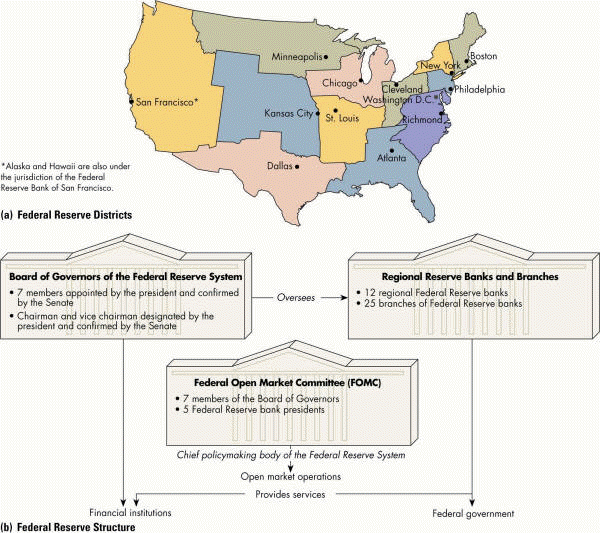
Functions of the Federal
Reserve System
-
Supplies the economy with fiduciary currency
-
Provides a system for check collection and clearing
-
Holds depository institutions’ reserves
-
Acts as the government’s fiscal agent
-
Supervises depository institutions
-
Acts as a lender of last resort
-
Regulates the money supply
-
Intervenes in foreign currency markets
Remember dealing with aggregate consumption,
production and / or investment?
Government influences the economy with
fiscal policy: Keynesian
The Fed influences the economy with monetary
policy: Monetarism
The Fed's Tools
Open market
operations
Buying and selling US Treasury securities
by the Federal Open Market Committee to control the money supply.
When the Fed buys securities there
is an increase in the money supply.
When the Fed sells securities there
is a decrease in the money supply.
Changes in
the discount rate
The interest rate the Fed charges for loans to
commercial banks.
Lowering the discount rate increases the money
supply.
Raising the discount rate decreases the money supply.
Changes in
the reserve requirement
Reserves that banks must keep to
back up their deposits.
Reserve requirements are the portion
of deposits that banks may not lend and have to keep either on hand or on deposit
at a Fed Bank.
The Phillips Curve
Shows the relationship between the unemployment rate
and inflation.
Key Formulas in Macroeconomics
I'm partial to
the first list but all of the lists below are good.
Key Formulas in Macroeconomics
Key Formulas for Macroeconomics
Main Macroeconomics Formulas
|