


|
|
|
Table of Contents
The US Congress and Domestic and Economic Policy The Presidency and Foreign Policy The National Bureaucracy The National Judicial System Civil Liberties and Civil Rights
The US Congress and Domestic and Economic Policy
I. Qualifications to Run for Congress
II. Congressional LeadershipA. Senate
B. House
On Oct. 3, 2023, the House removed
Kevin McCarthy (R, CA) as Speaker, after a small band of Republican
dissidents moved to oust him As Republicans had only a 9-member majority, any group of five Republican lawmakers could block progress if all Democrats were opposed. It was the fifth-narrowest margin in history, according to Pew Research Center. No Speaker had ever been removed from office before and the move put the Republicans at the mercy of a few dissidents, most of them members of the House Freedom Caucus. Unlike most of the dozens of caucuses and single-issue groups on Capitol Hill, the Freedom Caucus doesn’t publicize its membership, which reportedly is by invitation only. Estimates are that 22% of the House Republican conference either belongs to the Freedom Caucus or is closely aligned with it. Scott Perry (R, PA) is the Freedom Caucus chairman. Ideologically, Freedom Caucus members and allies are among the most conservative of House Republicans, with several falling on the rightmost end of the spectrum. They have also spent less time in the House than other members of the Republican conference (71% have served for 6 years or less and 9 are freshmen) and are more likely to come from the South. In January 2023, McCarthy agreed to more Freedom Caucus representation on the powerful Rules Committee and other key panels and agreed to a list of rule changes long sought by the Freedom Caucus, many of them intended to shift power away from the Speaker’s office and toward committee chairs and rank-and-file members. The deal enhanced the power of far-right Republicans at the expense of moderates who prefer to advance legislation that can win the approval of a Democratic-controlled Senate and White House. It also made McCarthy’s task of passing critical bills, such as funding the government and raising the debt ceiling, much harder. Worse, the concessions made the House ungovernable and resulted in multiple crises. Congress only wrote 21 laws in 2023, the least productive gathering of lawmakers since the Great Depression, as members drew more headlines for confrontations than for public policy-making. That's in no small part because the House devoted much of its floor time to partisan bills with no chance of advancing in the Senate - not to mention two protracted periods where the House had no Speaker.
III. Powers of Congressfound in Article 1, section 8, of the Constitution -
IV. How a Bill Becomes Law
| ||||||||||||||||||||||||||||||||||||||||||||||||||||||
|
No later than the 1st Monday in February |
The President transmits the budget, including a sequester preview report. |
|
Six weeks later |
Congressional committees report budget estimates to the Budget Committee. |
|
April 15th |
Action completed on congressional budget resolution. |
|
May 15th |
House consideration of annual appropriations bills may begin. |
|
June 15th |
Action completed on reconciliation. |
|
June 30th |
Action on appropriations completed by House. |
|
July 15th |
The President transmits the Mid-Session Review of the budget. |
|
August 20th |
OMB updates the sequester preview. |
|
October 1st |
The fiscal year begins. |
|
15 days after the end of a session of Congress |
OMB issues final sequester report and the President issues a sequester order if necessary. |
5 Facts about the US National Debt
Okay, Folks, Let's Put Aside Politics and Talk About Taxes...
Understanding the Federal Budget
Mandatory vs. Discretionary Spending
Where the Current National Debt Comes From
History of Presidents and Federal Income Tax
We the Economy Films: Chapter 3: What is the role of our government?
o Why is our tax system so complicated? Can a cartoon conquer a challenge like today’s tax system, with its ever-changing, 75,000 pages of laws? With retro flair, "Taxation Nation" looks into how our tax system does – and doesn’t – work.
o Where do our tax dollars go? Uncle Sam takes a cut of our earnings every April. But what does he spend our hard-earned money on? The answers will truly surprise you in this vérité odyssey.
o Why does the US fund foreign aid? The US spends approximately $37 billion dollars a year on foreign aid - just under 1% of our federal budget. "The Foreign Aid Paradox" zeroes in on food aid to Haiti and how it affects American farming and shipping interests as well as Haiti’s own agricultural markets. The result: a surprising study in unintended consequences.
o Why do we have budget deficits and a national debt? In this free-wheeling animated film, you’ll see how Congress and public officials use and manage debt, and why it matters to you.
 |
|
Budget Hero was launched in May 2008, re-launched in September 2012 and retired in August 2014 by Public Insight Network. I’m keeping the link ready (and my fingers crossed!) for the next re-launch. |


A. Must be a natural-born citizen of the US (can be born abroad of parents who are American citizens).
B. Must be 35 years of age.
C. Must be a resident of the US for at least 14 years (but not necessarily the 14 years preceding the election).

A. White House
The White House: Where the President and First Family live and conduct the people’s business
B. an office building
Eisenhower Executive Office Building: the offices of the White House staff
C. a chef
D. a salary of $400,000 per year (taxable)
E. expense account of $50,000 per year (taxable)
F. travel expenses of $100,000 per year (tax-free)
G. a place in the country: Camp David
H. a personal airplane: Air Force One
15 Amazing Things about Air Force One (20:46)
Air Force One: The President’s Office in the Sky
Air Force One: Everything You Need to Know - dated but interesting
I. a helicopter
New Marine One will change aviation. Best Helicopter Ever? (10:49)
Inside The New Marine One (10:08)
J. pension, on retirement, cabinet member's salary (taxable)
K. staff support on leaving the presidency
AIR FORCE ONE: OBAMA ON BOARD (2:36)
AIR FORCE ONE: BLACK, WITH EQUAL (0:40)
[If you see the message Error Loading Image in either of the two players above, just ignore it and hit the play button.]
The President is responsible for all military decisions. Ultimately, any military action taken by this nation is his responsibility. This is particularly important because of the nature of the use of weapons ... they start wars and people die.
The President is the nation's chief diplomat. It is his responsibility to negotiate treaties and conduct foreign affairs.
All of the heads of the agencies in Washington report to the President. In the end he is responsible for carrying out the law and making sure the bureaucracy runs efficiently.
Often the President suggests laws and he is always pushing for legislation he feels is important. In this function he often acts as a lobbyist, exerting pressure and shepherding bills through Congress. The President must also sign and/or veto legislation.
The President is the one office for which the entire nation votes. He represents and leads the nation. This is particularly difficult considering the contentious nature of politics. Often in trying to lead public opinion he only serves to enrage half of the country. That's what politics is all about.
The President is responsible for helping to get members of his party elected / reelected (as well as himself). While this is not an official function it is very time-consuming.
According to Article II of the Constitution the President has the following powers:
Serve as commander in chief of the armed forces
Commission officers of the armed forces
Grant reprieves and pardons for federal offenses (except impeachment)
Convene Congress in special sessions
Receive ambassadors
Take care that the laws be faithfully executed
Wield the "executive power"
Appoint officials to lesser offices
Powers shared with the Senate
Make treaties
Appoint ambassadors, judges and high officials
Powers shared with Congress
Approve legislation
Historically, the president's wife was little more than a campaign adornment and White House hostess. In modern times, however, that changed. Most Americans are now aware of the large role Eleanor Roosevelt played during her husband's presidential terms, even if they weren't aware at the time. Later presidential wives' power and influence depended in large part on what their husband's administration allowed them to have. That changed with Rosalynn Carter, who formalized and standardized the role of the first lady.
Whether or not they were supporters of Jimmy Carter, almost everyone considered his wife the most influential First Lady since Eleanor Roosevelt. Rosalynn Carter, a close political and policy adviser to her husband, President Jimmy Carter, created the modern office of the first lady. With her husband’s support and over the objections of others, she expanded the role of the first lady. She attended Cabinet meetings and security briefings, worked on mental health and other policy priorities, and formally created the Office of the First Lady in the East Wing with its own chief of staff. In May and June 1977, President Carter dispatched his wife on a diplomatic trip to Latin America that was substantive rather than social, and was unprecedented for a first lady. She engaged Central and South American government figures on issues that included human rights, beef exports, arms reduction, demilitarization, drug trafficking and nuclear energy. After each day’s talks, she filed a report with the US State Department. At many of her meetings, she spoke in Spanish, having recently completed an intensive language course.
The power and influence a specific first lady wields is and, to a large degree will remain, dependent on what that first lady is comfortable with and the sort of role she is interested in playing. Too, as we've seen with some of the first ladies since Rosalynn Carter, some presidents are not comfortable with their wives taking on any roles beyond White House hostess. Still, it is unlikely that first ladies will ever return to the largely background role played by their historical predecessors.
The American Presidency Project: State of the Union Messages
State of the Union videos and transcripts
How the State of the Union Became a Picture of Disunion: Historically, the SOTU doesn’t move the polls much. It’s mostly watched by highly engaged partisans who already hold firm views about the president.
White House Tapes: The President Is Calling
Supreme Court Nominations Not Confirmed
Most of Trump’s executive orders aren’t actually executive orders. Here’s why that matters.
The Art in the Oval Office Tells a Story
Video: FDR’s First Fireside Chat, 1933 (13:01)
Video: FDR Asks Congress for Declaration on War against Japan, 1941 (4:47)
Video: President Eisenhower’s Farewell Address, 1961 (9:28), in which he warns of the dangers of the unprecedented and vast military-industrial complex
Video: JFK’s Inaugural Address, 1961 (15:26)
Video: JFK’s Cuban Missile Crises Speech to the Nation, 1962 (16:58)
Video: JFK’s Speech near the Berlin Wall, 1963 (10:09)
Video: JFK’s Civil Rights Message, 1963 (10:41)
Audio: LBJ Takes Presidential Oath on Air Force One, 1963 (0:43)
Video: LBJ’s Comments on Returning to Washington after JFK’s Death, 1963 (0:42)
Video: LBJ Signs the Civil Rights Act, 1964 (9:57)
Video: LBJ’s Speech Withdrawing from His Re-election Campaign, 1968 (14:50)
Video: John Dean’s Testimony on the Watergate Cover-up, 1973 (17:35)
Video: Representative Barbara Jordan’s Statement to the House Judiciary Committee on the Proposed Impeachment of Pres. Nixon, 1974 (13:18)
Video: Pres. Richard Nixon’s Resignation Speech, 1974 (8:22)
Video: Pres. Jimmy Carter’s Fireside Chat on the Energy Crisis, 1977 (12:32)
Video: Pres. Reagan’s Star Wars Proposal, 1983 (20:31)
Video: Pres. Reagan Speaks at the Berlin Wall, 1987 (5:23)
Video: Pres. Reagan’s Farewell Address, 1989 (20:48)
White House Tapes: The President Calling: Three of America's most compelling presidents -- Kennedy, Johnson and Nixon -- bugged their White House offices and tapped their telephones. In this documentary project, American Radio Works eavesdrops on presidential telephone calls to hear how each man used one-on-one politics to shape history. Includes audio, a transcript of the documentary and background information on each president and the tapes.
Presidential Approval Ratings By Administration
Touring the White House (4:31)
How Two First Ladies Weathered a Most Unusual Presidential Transition
The executive branch consists of a number of different people/offices other than the president.
Traditionally, the power of the vice president has depended on the president. The Constitution makes the VP the 'president' of the Senate, but he has no actual power in the Senate. The Constitution mainly provides for a VP who waits around for the president to die. Few VPs, then, are given any real power by their president. Most presidents don't like their VPs (since each was chosen to balance a ticket and has little in common with
the president) and don't trust their VPs (since they assume the VP is out to replace him).
United States Naval Observatory: The Vice President’s Residence


The cabinet is the collective heads of the various executive departments - the head of State, Defense, Commerce, etc. The cabinet was intended to come together and act as a source of wisdom for the president on policy matters. After all, you have in one group the leading authority of every subject in the country. However, the cabinet has never been a major source of policy because members tend to think in terms of departmental interests, rather than national interest.
These are the presidential advisors that actually have offices in the White House. These people - the press secretary, the national security advisor, etc. - will always be the president's closest advisors since, unlike any other officials, they have daily access to the president.
These agencies report directly to the president and perform services directly for him but are not located in the White House. Their contact with the president is direct, but not as intimate as the White House staff. The Executive Office of the President includes such positions as the CIA director and the OMB director.
...the people who are responsible for implementation: putting specific policies into operation. The chief advantage of a bureaucracy is that is tends to standardize everything so that procedures and personnel can be easily transferred or replaced. Today over 85% of the government operates on the merit system. It is this vast group of people that add stability to the government. Presidents, congressman, judges may come and go but the bureaucracy remains the same. The chief disadvantage of a bureaucracy is that is tends to standardize everything so that people become numbers and problems become cases. How far can the bureaucracy go in the name of efficiency? By the way, most people who work in government don’t work in Washington: 85% of the federal workforce is based elsewhere, and nearly 18 million of the 20 million civilian government jobs are at the state and local level.
Homeland Security Knowledge Base
The legal system is a complicated one and can be confusing. I would like to
start by defining a few terms which are essential to any discussion of the
courts and criminal justice but with which you may have some difficulty. Feel
free to refer back to this list whenever you need to do so.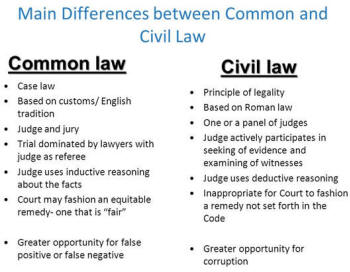
The world has two major legal systems: common law and civil law.
The common law legal system emphasizes the role of judges in determining the meaning of laws and how they apply (US, UK).
The civil law legal system relies more on legislature than judicial decisions to determine what the law is (France)..
There are also several types of law.
Constitutional Law: establishes the framework of the state whose purpose is to protect property in its broadest sense
Administrative and Regulatory Law: concerns the public laws that protect, tax, regulate or redistribute resources
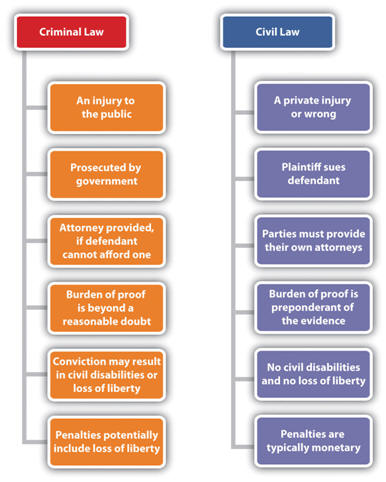
Criminal Law: considered to be crimes against the state. Crimes in Texas are divided into misdemeanors and felonies. Criminal cases involve a representative of government attempting to prove the wrong committed against society and seeking to have the wrongdoer punished by the court system. Because criminal law deals with crimes against the state, a person accused of violating the criminal code is tried by the state. The state pays for the trial, provides the defendant with an attorney if necessary, and pays for the punishment if the defendant is punished (e.g., prison time). Check your textbook for the graded offenses system we have in Texas. Pay attention, as well, to the newest type of offense - the state jail felony.
Civil Law: deals with relations between two private parties - for example, a business contract that has been violated. Civil cases may include suits for breach of contract or tort cases, such as suits for personal injuries. Typically, they involve a request for damages or other appropriate relief. In a civil action, the people involved must pay. The person who sues you must pay for his or her attorney and court costs. You must hire an attorney to defend you. The defendant pays for any punishment - a cash settlement, for example. (Don't confuse civil (or noncriminal) lawsuits with a civil law legal system, which is one emphasizing the importance of the legislature in determining the meaning of laws.)
In any given act, there may be grounds for both a criminal trial and a civil trial. The two are very different things, however, with different rules and what occurs in one has no bearing on what may occur in the other.
Tort Law: protects and compensates owners through private civil lawsuits when their resources are wrongfully harmed by the actions of others
Within the court system, not every court is able to hear every case. Jurisdiction: refers to the types of cases a court is competent to hear.
Some courts have only original jurisdiction, meaning that court may only hear a case the first time it is tried. Don’t let the idea of ‘first time’ confuse you. If a case ends in any way other than a verdict, if for example it ends in a mistrial or hung jury, it still hasn’t been heard the first time. If you are on trial for murder your first trial is an original case. If the trial ends in a hung jury - they cannot decide your guilt or innocence - and the district attorney decides to retry the case, the next case will still be an original case and must be heard by a court that has jurisdiction over original cases.
Once a verdict has been reached, however, you may appeal the decision to a court that has appellate jurisdiction, meaning that court hears cases on appeal. Some courts have only original jurisdiction. Some have only appellate jurisdiction. Some courts have both original and appellate jurisdiction.
In Texas, there are also several levels of courts, the higher of which have jurisdiction over the more important cases. (More about that below.)
There are many terms that are important during the legal process.
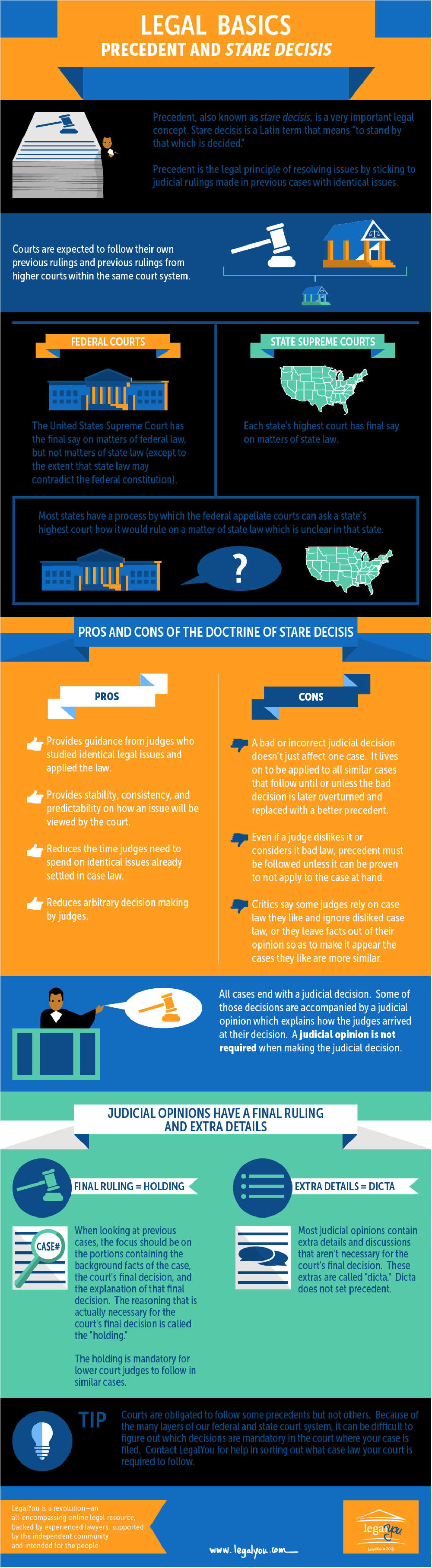
Stare Decisis: the doctrine of prior precedents. The Latin meaning is let the prior decision stand. Under stare decisis, judges in current cases follow whenever possible the interpretation of law determined by judges in prior cases.
Case Law: the judicial decisions that apply to a legal problem, a collection of past legal decisions written by courts and similar tribunals in the course of deciding cases.
Pros and Cons of Stare Decisis:
Pros: predictability, fairness, uniformity, efficiency
Cons: times change, distinguishable cases, conflicts/confusion, volume of cases
Substantive Law: defines the legal relationship of people with other people or between them and the state. Substantive due process is used to evaluate whether a law can be applied by states at all, regardless of the procedure followed. Substantive rules of law define rights and duties.
Procedural Law: deals with the method and means by which the substantive law is made and administered. Procedural rules of law provide the machinery for enforcing those rights and duties. Procedural due process, based on principles of fundamental fairness, addresses which legal procedures are required to be followed in state proceedings.
Beyond a Reasonable Doubt: the burden of proof required in a criminal case. The prosecution in a criminal case has the burden of proving the defendant is guilty and the jury must have no reasonable doubt about the defendant's guilt.
Preponderance of Evidence: the burden of proof required in a civil case. Requires the party with the burden of proof to demonstrate that an allegation or argument is more likely to be true than false. In other words, in light of the evidence and the law, do you believe that each element of his/her [claim/counterclaim] is more likely true than not?
Jury Instructions: a statement made by the judge to the jury informing them of the law applicable to the case. The jury is bound to accept and apply those instructions.
courts settle disputes, not policy matters
must have standing (be a party to the case and suffer damages)
must follow precedent or previous court decisions
courts are passive, not active like legislators or executives
Jurisdiction: the types of cases a court is competent to hear and decide
federal vs. state jurisdiction
federal: interstate commerce, immigration, terrorism, diversity of citizenship
state: murder, armed robbery, theft, intrastate commerce, state disputes
trial vs. appellate jurisdiction
trial court
questions of fact (guilt/innocence)
citizen participation (jury, witnesses): Although, as a citizen, you are most likely to participate in the judicial process through voting for a judicial candidate.
local matters
appellate/appeals court
questions of law and procedure
regional and national matters
set precedents for lower courts
The US Constitution created one national court - the Supreme Court - but did not mandate its structure. Instead the structure of the Supreme Court is determined by Congress. Originally, the Supreme Court had a chief justice and five associate justices. Today, it has a chief justice and 8 associate justices.
The Constitution also gave Congress the power to create any additional national courts necessary. Over time, the national court structure has evolved into what we have today, with 91 national district courts, 13 national appeals courts, the Supreme Court and a handful of specialized national courts.
THE STRUCTURE OF THE NATIONAL COURT SYSTEM
US District Courts (trial courts) and US Bankruptcy Courts
US Court of Appeals for the Armed Forces
Court of Appeals for Veterans Claims
 The
president appoints all national judges. Each level of the national court system has its own
jurisdiction (types of cases a court
is competent to hear and decide). The national district courts
are courts of
original jurisdiction, while the national appeals courts
have appellate jurisdiction. The Supreme Court has both types of
jurisdiction, depending on the case. It exercises its appellate jurisdiction
when it hears an appeal from a lower court. When the Supreme Court hears a case directly it is exercising original jurisdiction.
The
president appoints all national judges. Each level of the national court system has its own
jurisdiction (types of cases a court
is competent to hear and decide). The national district courts
are courts of
original jurisdiction, while the national appeals courts
have appellate jurisdiction. The Supreme Court has both types of
jurisdiction, depending on the case. It exercises its appellate jurisdiction
when it hears an appeal from a lower court. When the Supreme Court hears a case directly it is exercising original jurisdiction.
| Comparing National and State Courts |
|
|
Types of Supreme Court Cases Heard
The Supreme Court hears three types of cases:
⅔ are cases appealed from lower federal courts
⅓ are cases appealed from state supreme courts
Rarely, the court hear cases that have not been previously heard by a lower court, such as between one state's government and another.
The justices decide which cases they will hear, about 80 each year. The US Supreme Court decides fewer cases than any other court in modern times. In recent years, the Court has heard an average of about 80 cases a term, which is half the number they heard 20 years ago and makes up fewer than 1% of the approximately 10,000 review petitions they receive. They decide another 50 without hearing arguments. The cases they choose usually address constitutional issues or federal law. The Court decides cases based on merit: cases in which two lower courts have issued contradictory decisions and issues that have broad impact on the country. Judicial review is the power of courts to declare acts of Congress, actions of national executives or laws enacted by any level of government to be unconstitutional. There are many cases that don't get heard. If the justices decide not to hear a case, the decision of the lower court stands.
What Happens When the Supreme Court Hears a Case?
Typically, all nine of the justices hear each case. Sometimes less than the full nine justices may hear a case due to illness, a vacant position, or if one justice recuses him/herself (chooses not to participate in a case) due to conflict of interest. A minimum of six of the nine judges must be present to make a decision on a case.
Each case is decided by majority vote. In case of a tie, the decision of the lower court is upheld.
Since the court only reviews cases which are appealed from a lower court, there is no evidence presented, and no witnesses are heard. There are simply briefs (written arguments) and oral argument by the parties. Each side has 30 minutes to present oral arguments, and the justices interrupt with questions while they are speaking.
After the attorneys are finished speaking, the justices meet in secret to discuss the case and come to a decision. No official record is kept of this discussion.
When the Supreme Court announces what they have decided in a case, they issue a formal document called a decision, and sometimes more than one.
The conclusion of the court is a majority opinion.
The justices that disagreed with the majority vote may issue one or more dissenting opinions, explaining their reasons for disagreeing.
Sometimes, one or more justices may be on the majority side but disagree with the reasoning behind the decision, and issue a concurring opinion.
In recent years many long-held traditions of the Court have changed or been dropped without explanation. The Supreme Court building has been closed to the public since the beginning of the pandemic in 2020. Then, not long after the leak in early May 2022 of a draft of the opinion that overruled Roe v Wade, the Supreme Court building was surrounded by an eight-foot fence. Always cloistered and remote, the Court is now impenetrable.
For unexplained reasons, the justices have stopped announcing their decisions from the bench, abandoning a tradition that is both ceremonial and illuminating. In the old days, the author of the majority opinion would give a quick and conversational summary of the ruling that could be extremely valuable for a reporter on deadline and, by extension, for members of the public trying to understand a decision. More important yet were oral dissents, reserved for decisions that the justices in the minority believed were profoundly mistaken. Ordinarily, one or more of the justices who dissent in a case would raise their voices in protest. These days, the Court makes do with posting PDFs of its decisions, robbing the occasion of ceremony, drama and insight.
The Supreme Court opinion allowing Texas to ban nearly all abortions (2021) was different from most major rulings by the court. This one came out shortly before midnight. It consisted of a single paragraph, not signed by the justices who voted for it and lacking the usual detailed explanation of their reasoning. And there had been no oral arguments, during which opposing lawyers could have made their cases and answered questions from the justices. Instead, the opinion was part of something that has become known as “the shadow docket.” In the shadow docket, the court makes decisions quickly, without the usual written briefings, oral arguments or signed opinions. In recent years, the shadow docket has become a much larger part of the Supreme Court’s work. Shadow-docket cases are frequently those with urgency - such as a voting case that must be decided in the final weeks before an election. As a result, the justices don’t always have time to solicit briefs, hold oral arguments and spend months grappling with their decision. Doing so can risk irreparable harm to one side in the case. For these reasons, nobody questions the need for the court to issue some expedited, bare-bones rulings. But many legal experts are worried about how big the shadow docket has grown, including in cases that the Supreme Court could have decided in a more traditional way.
Why have the justices expanded the shadow docket? In part, it is a response to a newfound willingness by lower courts to issue decisions that apply to the entire country. By acting quickly, the Supreme Court can retain its dominant role. But there is also a political angle. Shadow-docket cases can let the court act quickly and also shield individual justices from criticism: In the latest abortion case, there is no signed opinion for legal scholars to pick apart, and no single justice is personally associated with the virtual end of legal abortion in Texas. The only reason that the public knows the precise vote - 5 to 4 - is that the four justices in the minority each chose to release a signed dissent. Critics argue that judges in a democracy owe the public more transparency. The idea of unexplained, unreasoned court orders seems so contrary to what courts are supposed to be all about. If courts don’t have to defend their decisions, then they’re just acts of will, of power. The shadow docket also leaves lower-court judges unsure about what exactly the Supreme Court has decided and how to decide similar cases they later hear. Because the lower-court judges don’t know why the Supreme Court does what it does, they sometimes divide sharply when forced to interpret the court’s non-pronouncements.
Currently, the court’s six Republican-appointed justices are driving the growth of the shadow docket, and it is consistent with their overall approach to the law. They are often (though not always) willing to be aggressive, overturning longstanding precedents, in campaign finance, election law, business regulation and other areas. The shadow docket expands their ability to shape American society. The three Democratic-appointed justices, for their part, have grown frustrated by the trend. Chief Justice Roberts also evidently disagrees with the use of the shadow docket in the Texas abortion case. In his dissent, joining the three liberal justices, he said the court could instead have blocked the Texas law while it made its way through the courts. That the court chose another path means that abortion is now all but illegal in the nation’s second-largest state.
One new line of reasoning recently introduced in SCOTUS arguments is the Major Questions Doctrine (MQD). Federal agencies are given great power to operate within the authority granted to them by Congress. Historically, courts have given agencies broad discretion as long as they are not operating in a way that is not expressly restricted and where they can show that their interpretation is reasonable. However, the MQD, a term the Court never used in a majority opinion prior to 2022, is a principle of statutory interpretation in US administrative law which states that courts will presume that Congress does not delegate to executive agencies issues of major political or economic significance. When the US Supreme Court issued its 2022 decision in West Virginia v. Environmental Protection Agency, the majority concluded that the EPA’s policy involved a major question, and that the agency went too far in its attempt to regulate, without explicit permission from Congress to do so. This signaled a turn away from how the Court traditionally interpreted statutes and was at odds with the normal tools of statutory interpretation. Advocates of limiting the power of the federal bureaucracy cheered, while others worried that it could prevent the government from taking decisive action on urgent problems like climate change, student loans, healthcare and so on. Under the MQD, courts make an initial finding of whether something has vast political or economic implications - and if so, the agency loses. The MQD stops agency action, even if a law potentially gives them the power, until Congress authorizes the action again clearly. That seems okay because Congress can, in principle, still act. But the odds of current congressional action are quite poor. Congress, in other words, isn’t going to do what the MQD says it is meant to do. The MQD could potentially be quite harmful since the whole point of an administrative state is to allow broad delegation to agencies. It suggests that the Court does not really respect governmental choices about delegating power to agencies. Rather, the Court looks like an imperial court, motivated by power, not reason. And the MQD stops healthy action, especially in areas where it’s most needed - like climate action or regulation of emerging technologies. The MQD seems to be simply an expression of judicial aggrandizement. It creates a bureaucracy unable to function and imposes an unconstitutional judicial limit on US administrative law. The major questions doctrine inherently benefits the status quo, and with industry, the environment and society evolving at a pace far faster than Congress can legislate with the specificity required, the ruling has cast doubt on how agencies will be able to act on the major issues of our day. If Congress will not act on important issues because the parties are too busy fighting, and the Court stops agencies and the President (see Biden v. Nebraska (2023)) from acting, the country is going to be in real trouble.
What Do Supreme Court Justices Do Besides Hear Cases?
In remarks in May 2022, Justice Clarence Thomas reflected on how things had changed at the Court since an 11-year stretch without changes in its membership before the arrival of Chief Justice John Roberts in 2005. “This is not the Court of that era,” Justice Thomas said, adding: “We actually trusted each other. We may have been a dysfunctional family, but we were a family.” A less collegial Court seems like it could be especially problematic for justices in the minority. There are now five Republican-appointed justices who are even more conservative than Chief Justice Roberts. If the Court is a less collaborative place, it probably gives justices in the minority less ability to shape decisions. It’s possible to overstate the power of collegiality, though. Justices cast votes based on the strength of the relevant arguments and the desired outcomes, not on how likable their colleagues are. The justices also say there is no vote-trading across cases. On the other hand, there are certainly negotiations within cases. It seems fairly clear, for instance, that Justices Breyer and Kagan shifted positions in one part of the 2012 case that upheld a key portion of the Affordable Care Act to make certain they would secure Chief Justice Roberts’s vote on another part. Justices may well be prepared to narrow or reshape a draft opinion that seeks to speak for a five-justice majority in exchange for a vote. But once the author has gotten to five, the value of another potential vote plummets. It is that dynamic that must worry the Court’s minority justices.
Table for Nine (Lunch at the US Supreme Court)
Speaking of collegiality … On June 30, 2022, Justice Breyer officially retired and helped swear in his replacement, Justice Ketanji Brown Jackson. When a new justice joins the Supreme Court, tradition requires the second-most junior justice to arrange a little party. In 2006, for instance, when Justice Samuel Alito came on board, that task fell to Justice Breyer, who knew his new colleague to be a Phillies fan. Before dessert was served, Justice Breyer introduced a special guest: the Phillie Phanatic, the team’s mascot. This year, Justice Amy Coney Barrett is the second-most junior justice and will presumably be in charge of the welcoming celebration for Justice Jackson.
The Court is in recess from sometime near the end of June until October each year. During the break justices analyze new petitions for review, consider motions and applications, study argued and forthcoming cases and work on their opinions, travel extensively, make public appearances and speeches (for which they are well compensated), and write books and articles. The justices often teach courses in exotic places. In 2012, for instance, after voting to uphold the Affordable Care Act (and thus angering Republicans), Chief Justice Roberts left for Malta to teach a two-week class on the history of the US Supreme Court. “Malta, as you know, is an impregnable island fortress,” Roberts said. “It seemed like a good idea.”
Because the justices do not meet to decide whether to grant or deny review in cases during the summer months, thousands of legal petitions pile up during their absence. The Court plows through this backlog at their first conference (aptly referred to as the “long conference”) in the last week of September. But they obviously cannot give these petitions the same consideration as those that arrive later in the term. (For this reason, savvy appellate attorneys know that it is best to avoid filing petitions over the summer if they can.) When pressing issues arise during the recess, the matter is often handled by a single justice “in chambers” who must make important decisions about whether to grant stays, injunctions or extensions without consulting with his/her absent colleagues.
A charity tied to the Supreme Court offers donors access to the Justices.
Former Anti-Abortion Leader Alleges Another Supreme Court Breach
Supreme Court Jurisdiction
Under the Constitution, federal courts exercise only judicial powers. The Supreme Court only considers cases that are justiciable:
o the petitioner has standing to sue (stake in outcome): In an actual case or controversy, the plaintiff in a federal lawsuit also must have legal standing to ask the court for a decision. That means the plaintiff must have been aggrieved, or legally harmed in some way, by the defendant. This means that federal judges may interpret the law only through the resolution of actual legal disputes, referred to in Article III of the Constitution as “Cases or Controversies.” A court cannot attempt to correct a problem on its own initiative, or to answer a hypothetical legal question.
o the case is ripe for decision (will have an impact on the country)
o it is not moot (has not already been decided): it must present an ongoing problem for the court to resolve
o it is not a political question (an issue with which the Congress or the President should deal)
The case must present a category of dispute that the law in question was designed to address, and it must be a complaint that the court has the power to remedy. In other words, the court must be authorized, under the Constitution or a federal law, to hear the case and grant appropriate relief to the plaintiff. The federal courts, thus, are courts of limited jurisdiction because they may only decide certain types of cases as provided by Congress or as identified in the Constitution .Although the details of the complex web of federal jurisdiction that Congress has given the federal courts is beyond the scope of this brief discussion, it is important to understand that there are two main sources of the cases coming before the federal courts: federal question jurisdiction and diversity jurisdiction.
In general, federal question jurisdiction arises in cases that involve the US government, the US Constitution or federal laws, or controversies between states or between the United States and foreign governments. A case that raises such a federal question may be filed in federal court. Examples of such cases might include a claim by an individual for entitlement to money under a federal government program such as Social Security, a criminal prosecution by the government that alleges someone violated a federal law, or a challenge to actions taken by a federal agency.
A diversity jurisdiction case also may be filed in federal court based on the diversity of citizenship of the litigants, such as between citizens of different states or between US citizens and those of another country. To ensure fairness to the out-of-state litigant, the Constitution provides that such cases may be heard in a federal court. An important limit to diversity jurisdiction is that only cases involving more than $75,000 in potential damages may be filed in a federal court. Claims below that amount may only be pursued in state court. Moreover, any diversity jurisdiction case regardless of the amount of money involved may be brought in a state court rather than a federal court.
Federal courts also have jurisdiction over all bankruptcy matters, which Congress has determined should be addressed in federal courts rather than the state courts. Through the bankruptcy process, individuals or businesses that can no longer pay their creditors may either seek a court-supervised liquidation of their assets, or they may reorganize their financial affairs and work out a plan to pay their debts.
Although federal courts are located in every state, they are not the only forum available to potential litigants. In fact, the great majority of legal disputes in American courts, civil or criminal, are addressed in the separate state court systems. State courts have jurisdiction over virtually all divorce and child custody matters, probate and inheritance issues, real estate questions, and juvenile matters, and they handle most criminal cases, contract disputes, traffic violations, and personal injury cases. In addition, certain categories of legal disputes may be resolved in special courts or entities that are part of the federal executive or legislative branches or state and federal administrative agencies.
HOW A CASE GETS TO THE SUPREME COURT

o The Constitution sets certain outer limits by guaranteeing certain rights and liberties.
o Past decisions – Precedents must serve as general guidelines for current decisions. A super-precedent is a case that is so deeply embedded in the fabric of the law that it should be especially hard to overturn, a decision so widely accepted that it is invulnerable to serious legal challenges that could see it overturned, a cases that is so well settled that no one seriously pushes for its overruling, e.g., Brown v. Board of Education (1954 ruling that outlawed racial segregation in public schools), Marbury v. Madison (1803) decision giving courts the authority to strike down laws as unconstitutional. Recent decisions by the current very conservative Court, however, have shown that the current Court does not feel bound by precedent.
o The Supreme Court does not have any enforcement power. However, as recent decisions have shown, if state legislatures agree with the Court, they will provide enforcement power of the Court's decisions.
o The Supreme Court relies on public acceptance of its rulings ... although that seems to be changing. The Court's rejection of Roe v. Wade and a constitutional right to reproductive choice (2022) was unpopular with an overwhelming majority of the country.
SCOTUS asked governors to quell non-violent protests.
o The public must be
willing to follow a ruling even if it doesn't like it.
o Congress can rewrite legislation so that it avoids the rational the Supreme Court gave for its decision..Of course, this assumes a Congress that can agree on legislation.
Congress has the power to override Supreme Court rulings.
o We can amend the Constitution, which could negate any ruling the Supreme Court may have made on any applicable issue. However, as the past has shown, amending the US Constitution is difficult, perhaps impossible in modern times.
There are limits to the Supreme Court’s power: Political progressives and moderates who are alarmed about the 2022 Court - the combination of its aggressiveness and the relative youth of its conservative members - have many options for confronting it.
Some options are fairly radical, like changing the size of the Court or passing a law declaring any subject to be off limits from Supreme Court review (both of which, to be fair, have happened in previous centuries). Other options are more straightforward. They involve the basic tools of democratic politics: winning over public opinion and winning elections. The founders did not design the Court to be the final arbiter of American politics, anyway. At the state level, progressives still have the ability, for example, to protect abortion rights, so long as they can persuade enough voters. At the federal level, Congress has more authority to defy Court decisions than many people realize. For example, the same-sex marriage bill is so intriguing because it is a rare recent instance of Congress acting as a check and balance on the Supreme Court, just as the founders envisioned and the Constitution allows.
When the Court overturns a specific law, Congress can often pass a new law, written differently, that accomplishes many of the same goals. Congress took this approach with civil rights starting in the 1980s, including with the Lilly Ledbetter Fair Pay Act of 2009, which made it easier for workers to sue for pay discrimination. The law was an explicit response to a Supreme Court ruling against Ledbetter. More recently, however, Congress has been too polarized and gridlocked to respond to Court decisions. As a result, the courts have tended to dominate federal policy, by default.
However, after the Court’s abortion decision in June 2022 contained language that seemed as if it might threaten same-sex marriage rights, House Democrats quickly proposed a marriage bill that would defang any future Court decision. The Court could still issue a ruling allowing states to stop performing same-sex marriages but the House bill would require one state to recognize another state’s marriage. Two women or men who married in, say, California would still be legally married in South Carolina even if it stopped performing same-sex weddings. According to a recent Gallup poll, 71% of Americans support same-sex marriage.
[It should be noted that progressives still face obstacles to achieving their goals through Congress. The Senate has a built-in bias toward rural, conservative states. The House suffers from gerrymandering (although 2022’s districts don’t actually give Republicans a big advantage). And the Supreme Court has made it easier for states to pass voting restrictions.]
Still...
The Right accuses the Supreme Court of being too liberal.
The Left accuses the Supreme Court of being too conservative.
If both Republican and Democratic presidents have been able to make their share of Supreme Court nominations over time (and that's a big "if" given the US Senate's behavior regarding Court appointees in the last decade), can we not say that, over time, we have had a balanced Supreme Court? As of 2022, however, an ambitious Republican-appointed majority controls the Supreme Court even though Democrats have won the popular vote in seven of the past eight presidential elections.
Virtual Tour of the Supreme Court
The justices usually make an effort to treat one another respectfully. They disagree on the law, sometimes harshly, while maintaining productive and even warm relationships, like the famous friendship between Antonin Scalia and Ruth Bader Ginsburg.
Rule of LawGranting Certiorari How Courts Work
Understanding the Federal Courts (PDF)
Interactive Supreme Court Timeline
State Courts vs. Federal Courts: Which court hears the case?
United States Supreme Court Cases
Landmark Supreme Court Rulings
Freedom of the Press Court Cases
The Supreme Court’s Secret Power
The first Supreme Court was held on this day 226 years ago
Why November 8, 2016 is Judgment Day for the Supreme Court ... and Our Rights
Ruth Bader Ginsburg’s Advice for Living
Amy Coney Barrett Says Roe v. Wade Is Not Super-Precedent
Why the Supreme Court Probably Doesn’t Care What Most Americans Think about Abortion or Gun Rights
Gridlock in Congress has amplified the power of the Supreme Court.
What We Lose as John Roberts Is Sidelined on the Court
Religious Doctrine, Not the Constitution, Drove the Dobbs Decision
How the End of Roe Will Impact Women of Color in Texas
Dobbs v Jackson (2022), annotated
Full Text of Supreme Court Justices' Dissenting Opinion on Dobbs v Jackson
The Legal Reasoning Behind the Supreme Court Overturning Roe v. Wade (5:58)
A History of Key Abortion Rulings of the US Supreme Court
How a Corporate Law Firm Led a Political Revolution
The Supreme Court Just Keeps Deciding It Should Be Even More Powerful
Justice Alito’s crusade against a secular America isn’t over.
The Supreme Court is blowing up law school, too.
Takeaways from the latest controversial and contentious Supreme Court term
What is Originalism? Debunking the myths
The roots of today's authoritarianism come from a 19th century Supreme Court ruling.
As unanimity declines, conservative majority’s power runs deeper than the blockbuster cases.
10 ways to fix a broken Supreme Court
“I Cannot Think of Many Things More Frightening”: The Supreme Court Has Declared War on Governing (WV v. EPA)
The Supreme Court’s Extreme Power Grab (WV v. EPA)
Supreme Court Holds Swearing In Ceremony for Ketanji Brown Jackson
 IV.
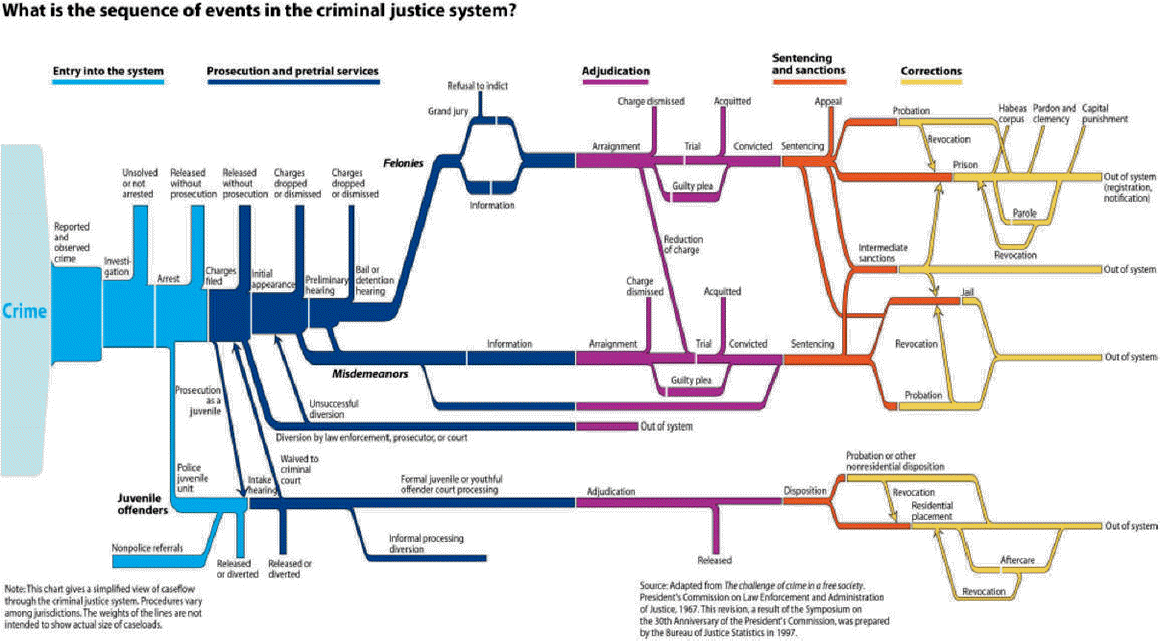
National Criminal Justice System
IV.
National Criminal Justice SystemA federal crime or federal offense is an act that is illegal under US law. Examples include tax evasion, possession of weapons banned by the National Firearms Act, mail fraud, aircraft hijacking, espionage, and assassinating or attempting assassination of the President or Vice President. A federal crime is prosecuted under federal criminal law, not under state criminal law. The US district courts are the general trial courts of the US federal courts. Both civil and criminal cases are filed in the district court. Prosecution guidelines are established by the US Attorney in each federal judicial district and by federal laws. The Federal Bureau of Prisons (BOP) is the US federal law enforcement agency within the Department of Justice that operates US federal prisons and is responsible for the care, custody and control of federal prisoners. The US has the largest population of incarcerated people in the world.
The American system of government is based on the concept that power flows from the people to the government.
|
|
|
|
|
|
|
|
When the power of government is limited by a framework of fundamental written law,
that government is said to be constitutional.

...prohibitions against government interference in the lives of its citizens
Civil liberties refer to individuals in general situations.
my right to say what I please on the street
your right to worship in the church of your choice.
Civil liberties guarantee individuals freedom from government intrusion into their lives.
Government does not provide liberty but it can provide the condition of legal order necessary for liberty.
Government can get too strong without restraint -- thus the Bill of Rights -- but civil liberties are significant only if individuals use them.
Civil liberties are found in the Bill of Rights, Articles 1, 3 and 6, and in various Congressional laws -- for example, the Freedom of Information Act and the Privacy Act.
Liberties Guaranteed in the US Constitution (before the Bill of Rights was added)
May not suspend writs of habeas corpus (except during invasion or rebellion).
Congress or states may not pass bills of attainder.
Congress and states may not pass ex post facto laws.
The right of trial by jury in criminal cases is guaranteed.
Citizens of each state are entitled to the privileges and immunities of the citizens of every other state.
No religious test or qualification for holding federal office are imposed.
States may not pass laws impairing the obligation of contracts.
Protections Afforded Citizens to Participate in the Political Process
Amendment 1: Freedom of religion, speech, press and assembly; right to petition government
Protections against Arbitrary Police and Court Action
Amendment 4: No unreasonable searches or seizures
Amendment 5: Grand jury indictment required to prosecute an individual for a serious crime, no double jeopardy (being tried twice for the same offense), forcing an individual to testify against himself prohibited, no loss of life, liberty or property without due process
Amendment 6: Right to a speedy, public, impartial trial with defense counsel and right to cross-examine witnesses
Amendment 7: Jury trials in civil suits where value exceeds $20
Amendment 8: No excessive bail or fines, no cruel and unusual punishments
Protections of States' Rights and Unnamed Rights of People
Amendment 9: Unlisted rights necessarily denied
Amendment 10: Powers not delegated to US or denied to states are reserved to states
Other Amendments
Amendment 2: Right to bear arms
Amendment 3: Troops not quartered in homes in peacetime
Although the Bill of Rights is the fundamental charter of American civil liberties, the Supreme Court determines how those rights are defined and applied.
Civil liberties were established at a time when the common perception was that individuals could take care of themselves if government left them alone. Gradually Americans became less optimistic about the individual's ability to take care of himself and more optimistic about the government's ability to take care of people.
Do you think this has led to our willingness to allow our freedoms to erode? Do we now say "the government can have my freedom of privacy if they will keep drugs off of my street"? If so, have our priorities shifted?
Know Your Rights: What to Do...

...If You're Stopped by the Police
Think carefully about your words, movement, body language and emotions.
Don't get into an argument with the police.
Remember, anything you say or do can be used against you.
Keep your hands where the police can see them.
Don't run. Don't touch any police officer.
Don't resist even if you believe you are innocent.
Don't complain on the scene or tell the police they're wrong or that you're going to file a complaint.
Do not make any statements regarding the incident. Ask for a lawyer immediately upon your arrest.
Remember officers' badge and patrol car numbers.
Write down everything you remember ASAP.
Try to find witnesses and their names and phone numbers.
If you are injured, take photographs of the injuries as soon as possible, but make sure you seek medical attention first.
If you feel your rights have been violated file a written complaint with police internal affairs division or a civilian complaint board.
...If You're Stopped for Questioning
It's not a crime to refuse to answer questions, but refusing to answer can make the police suspicious about you. If you are asked to identify yourself, see #2 at the bottom.
Police may "pat-down" your clothing if they suspect a concealed weapon. Don't physically resist but make it clear that you don't consent to any further search.
Ask if you are under arrest. If you are, you have a right to know why.
Don't bad-mouth the police or run away even if you believe what is happening is unreasonable. That could lead to your arrest.
...If You're Stopped in Your Car
Upon request, show them your driver's license, registration, and proof of insurance. In certain cases, your car can be searched without a warrant as long as the police have probable cause. To protect yourself later, you should make it clear that you do not consent to a search. It is not lawful for police to arrest you simply for refusing to consent to a search.
If you're given a ticket, you should sign it; otherwise you can be arrested. You can always fight the case in court later.
If you're suspected of drunk driving (DWI) and refuse to take a blood, urine or breath test, your driver's license may be suspended.
...If You're Arrested or Taken to a Police Station
You have the right to remain silent and to talk to a lawyer before you talk to the police. Tell the police nothing except your name and address. Don't give any explanations, excuses or stories. You can make your defense later, in court, based on what you and your lawyer decide is best.
Ask to see a lawyer immediately. If you can't pay for a lawyer, you have a right to a free one and should ask the police how the lawyer can be contacted. Don't say anything without a lawyer.
Within a reasonable time after your arrest, or booking, you have the right to make a local phone call: to a lawyer, bail bondsman, a relative or any other person. The police may not listen to the call to the lawyer.
Sometimes you can be released without bail or have bail lowered. Have your lawyer ask the judge about this possibility. You must be taken before the judge on the next court day after arrest.
Do not make any decisions in your case until you have talked with a lawyer.

If the police knock and ask to enter your home, you don't have to admit them unless they have a warrant signed by a judge.
However, in some emergency situations (like when a person is screaming for help inside or when the police are chasing someone) officers are allowed to enter and search your home without a warrant.
If you're arrested, the police can search you and the area close by. If you are in a building, close by usually means just the room you are in.
What you say to the police is always important. What you say can be used against you and can give the police an excuse to arrest you, especially if you bad-mouth a police officer.
You must show your driver's license and registration when stopped in a car. Otherwise, you don't have to answer any questions if you are detained or arrested, with one important exception. The police may ask for your name if you have been properly detained and you can be arrested in some states for refusing to give it. If you reasonably fear that your name is incriminating, you can claim the right to remain silent, which may be a defense in case you are arrested anyway.
You don't have to consent to any search of yourself, your car or your house. If you DO consent to a search, it can affect your rights later in court. If the police say they have a search warrant, ASK TO SEE IT.
Do not interfere with or obstruct the police ... you can be arrested for it.
We all recognize the need for effective law enforcement, but we should also understand our own rights and responsibilities, especially in our relationships with the police. Everyone, including minors, has the right to courteous and respectful police treatment. If your rights are violated, don't try to deal with the situation at the scene. You can discuss the matter with an attorney afterwards or file a complaint with Internal Affairs or the Civilian Complaint Board.
Produced by the American Civil Liberties Union.
...regulations permitting state interference to guarantee rights of full political participation to groups excluded by law, custom or condition of poverty
Civil rights are the freedom or opportunity to take part in government. They usually come about after a struggle leading to new laws that offer guarantees to a previously excluded group. America's history is one of the extension of opportunity to participate in politics to more and different groups of people.
Expansion of the franchise (right to vote) is an obvious example of civil rights struggles.
Amendment 15 gave African Americans right to vote.
Amendment 19 gave women right to vote.
Amendment 26 gave 18-to-20 year olds right to vote.
Specific civil rights are found in Amendments 13-15, 19, 24 and 26.
In addition, Congress has passed a number of Civil Rights Acts over the past several decades.
Although the civil rights movement of African Americans is the most obvious struggle, it is certainly not the only one. Other groups -- women, Hispanics, gays and lesbians, migrant workers, children, disabled -- have struggled and continue to struggle to increase their rights in the system.
Homo Stereotypus--Wired for Trouble
Pew Report: 5 facts about race in America
A list of the 20 essential films since 2000 that capture the American Latino experience
Video: FDR’s Four Freedoms Speech, 1941 (2:37)
Video: Government Film on the Internment of Japanese and Japanese-American Citizens by the US during WWII, 1942 (18:03)
Video: Little Rock School Integration Crisis, 1957 (1:57)
Video: Pres. Eisenhower’s Response to Little Rock School Integration Crisis, 1957 (13:34)
Video: MLK’s I Have a Dream Speech at the Lincoln Memorial, 1963 (16:22)
Video: Gov. Wallace Resisting Integration at the University of Alabama, 1963 (3:29)
Audio: Malcolm X’s The Ballot or the Bullet Speech, 1964 (52:46)
Video: Selma Alabama Civil Rights March and Confrontation, 1965 (4:13)
Video: Pro-Choice March, Washington, 2004 (2:29)
Video: Pro-Life March, Washington, 2005 (1:58)
FBI monitored Aretha Franklin for years, file shows.
The Perils and Promise of America's Third Reconstruction
The 2020 Black-White Wage Gap Was as Big as It Was in 1950
|
|


 during a dramatic vote with no
precedent in US history. McCarthy became the first Speaker of the
House to be removed via a procedure known as a motion to vacate.
The motion-to-vacate rule had been used unsuccessfully 3 times
previously, beginning in 1910, but required a majority of the party
to bring it to the House floor. McCarthy was made vulnerable by the
Republican’s thin majority - just 221-212 - and because as a
condition of his becoming speaker he agreed to a rule that any
single member could file a motion to vacate. Matt Gaetz (R, FL) led
the charge to remove McCarthy, putting his motion to vacate the
chair - to oust the Speaker - up for a vote. Following the
motion-to-vacate vote, Rep. Patrick McHenry (R, NC) stepped in as speaker pro tempore of the House, under post-9/11 rules
requiring the Speaker to name a temporary replacement in case of a
vacancy. McHenry immediately gaveled the session to a close.
during a dramatic vote with no
precedent in US history. McCarthy became the first Speaker of the
House to be removed via a procedure known as a motion to vacate.
The motion-to-vacate rule had been used unsuccessfully 3 times
previously, beginning in 1910, but required a majority of the party
to bring it to the House floor. McCarthy was made vulnerable by the
Republican’s thin majority - just 221-212 - and because as a
condition of his becoming speaker he agreed to a rule that any
single member could file a motion to vacate. Matt Gaetz (R, FL) led
the charge to remove McCarthy, putting his motion to vacate the
chair - to oust the Speaker - up for a vote. Following the
motion-to-vacate vote, Rep. Patrick McHenry (R, NC) stepped in as speaker pro tempore of the House, under post-9/11 rules
requiring the Speaker to name a temporary replacement in case of a
vacancy. McHenry immediately gaveled the session to a close.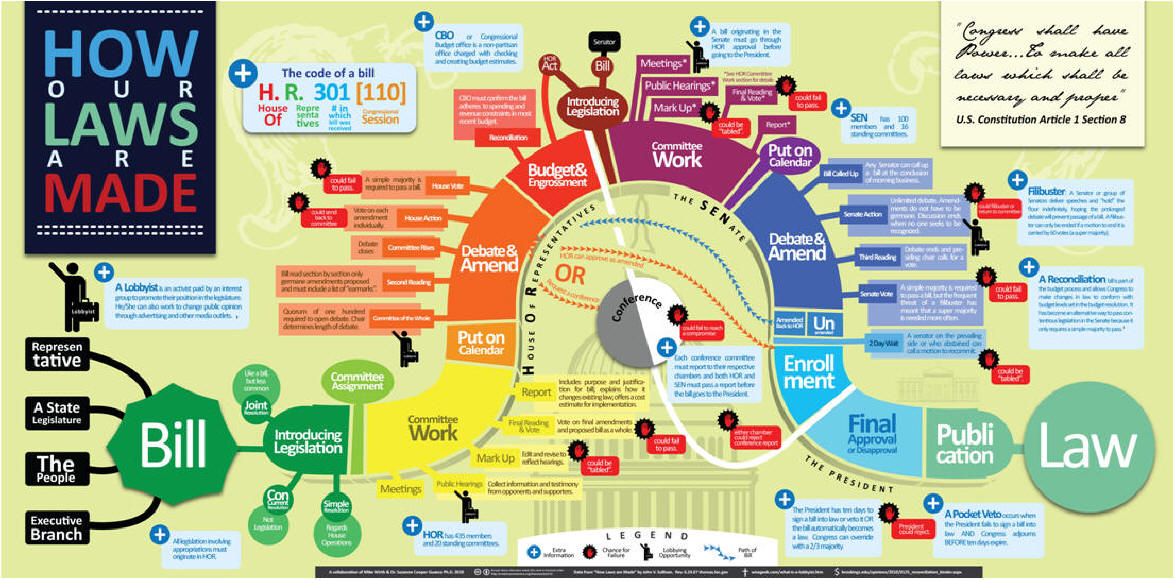
 bill assigned a number (HR 1 or SB 1)