

|
|
|
Table of Contents
Political Socialization Public Opinion The Media Interest Groups Political Parties Voting Behavior Campaigns and Elections
Political SocializationPolitical socialization is the process by which people acquire a set of political attitudes and form opinions about social issues.
Agents of Political SocializationFamily Neighbors Peer group Career School Co-Workers Religion Community Organizations Media Life stage Higher Education Political values change almost throughout your life. The most important influences on your political values, however,
occur during your early life. Your family, school, community (religious organizations, youth groups, civic activities) and your peer groups have
the most profound effects. It is your family that gives you that basic attitude toward government that you will carry with you throughout your life.
-from National Election Study data
Family is the single most important factor in your political socialization. However, throughout your life, your political values are influenced by college, adult peers (workers, friends, neighbors, spouses), political leaders, media and your political experiences. Too, the maturation process alone will affect your political values. Until you have children, you will care little for public school issues. Until you own a home, you will care little for property tax issues. Political socialization, to a greater or lesser degree, will continue throughout your life.
The opinions you form exist at three basic levels.1. values and beliefsmost abstract broad principles Sam Huntington: liberty equality, individualism, rule of law 2. political orientationtranslation of values and beliefs into a systematic way of assessing the political environment partisanship: psychological attachment to a party ideology: consistent set of values and beliefs about the purpose and scope of government 3. political preferencesattitudes about specific issues / candidates campaigns have little effect on voting choices ... routine personal contact with family, neighbors, co-workers and other acquaintances is the predominant influence
Public Opinion
Governments tend to react to public opinion. The fact that a public official serves at the pleasure of the voters usually tends to make that official sensitive to public opinion. American public opinion has some unique characteristics. The public's attitudes toward a given government policy vary over time. The majority of American voters stand somewhere near the middle ground on most issues in American politics.
Americans tend to fall into one of four categories based on how knowledgeable they are about politics and government.
American citizens are more than willing to express opinions about things of which they are totally ignorant. American public opinion is pragmatic, rather than ideological. We may often talk theoretically but we act practically. That does not mean we don’t have political ideologies but it does mean we probably aren’t ideologues in the true sense of the word. American public opinion is: uninformed inconsistent unconnected Wlezien's Thermostatic Model: Government responds to public opinion but often overshoots it, causing the public to move in the opposite direction. post-truth: relating to or denoting circumstances in which objective facts are less influential in shaping public opinion than appeals to emotion and personal belief
I. Public Opinion Polls
The population is the group of people you’re interested in studying. The sample is that part of the population considered to represent the entire population. A poll is a type of survey or inquiry into public opinion conducted by interviewing a representative sample of the population. population vs. sample / target population vs. random sample A random sample is the result of a process that selects a sample from the larger population entirely by chance. A poll’s sampling error tells you how much confidence you can have in the findings of the poll. The smaller the sampling error is, the more confidence you can have that the findings are accurate. The larger the sample is in relation to the population, the smaller the error. In general, you should look for a sampling error of ±3% … any poll with an error larger than ±5% is probably not worth the paper it’s printed on. Properly conducted scientific polls are highly accurate and the data generated by an opinion poll are used to measure and analyze public opinion. SLOPs (self-selected listener opinion polls), CRAPs (computerized response audience polling), intercept polls, FRUG polls (fund raising under the guise of polls) and push polls are neither scientific nor accurate. In fact, push polls only pretend to be polls in order to "push" you into believing something, e.g. "If you found out that the local community college has been overcharging students for their tuition, would you continue to attend your local college?" Push polls don't really care about your opinion ... they're trying to get you to believe their opinion.
II. Qualities of Public Opinion
Be a Critical Observer of Polls
1. Who Was Interviewed?
| ||||||||||||||||||||||||||||||||||||||||||||||||||||||||||||||||||||||||||||||||||||||||||||||
|
Media Effect on Politics |
|
|
Positives |
Negatives |
|
Increased knowledge |
Increased voter skepticism |
|
Agenda setting |
Reduced choice of candidates |
|
Candidate orientation |
Politics as a game for the financial elite |
|
Candidate issue positions |
|
|
Media technology gives candidates tools |
|
|
Media help candidates identify "hot" issues |
|
5 Ways New Media Are Changing Politics
Video: Segment of VP Spiro Agnew’s Speech Attacking the Press, 1969 (1:11)
Video: Gov. Bill and Hillary Clinton Discussing Accusations of his Infidelity, 1992 (6:24)
More negative than ads
One-third of candidate messages are negative
Two-thirds of news coverage is negative
Structural bias in media
Early negative coverage is hard to shake
News organizations shape sound bites from stories
Emphasize the dramatic
No meaningful context
Truth or Fiction: A non-partisan website where internet users can quickly and easily get information about eRumors, fake news, disinformation, warnings, offers, requests for help, myths, hoaxes, virus warnings and humorous or inspirational stories that are circulated by email.
PolitiFact: Staffers research statements and rate their accuracy on the Truth-O-Meter, from True to False. The most ridiculous falsehoods get the lowest rating, Pants on Fire.
 |
 |
|
It's more important than ever to be critical online. Why Fact Check? A world with or without fact checking? We know what we prefer. (1:33)
|
|
Convey information that will evoke positive feelings about the candidate
Information can be positive or negative
Define candidate and issue positions
Define opponents
Candidate controls content
Candidate controls the appeal
Stress image and issues
Measure citizens’ responses
Reinforce long-held predispositions about issues, personalities, political parties
Increasingly negative
Positive ads have to run again and again and again to stick
Negative ads move poll numbers in three or four days
System rewards those who win ... more important than voter turnout
What does the research say about negative advertising?
Negative ads do not increase participation.
Negative ads reduce positive attitudes toward candidates and races.
Attack advertising extracts a toll on participation: voting drops by 2.5% with negative ads and increases by the same amount with a positive ad. It's strongest effect is on independents.
Provides valuable information.
Reveals information about candidate's strengths or weaknesses.
Stimulates the base into action.
More knowledgeable voters are most likely to pay attention to ads.
Negative ads are given more weight.
Negative ads produce stronger emotional effects than positive ads.
The Negative Consequences of Uncivil Political Discourse (PDF)
Behind the Scenes of a Presidential Primary (3:41): Ever wondered what goes into covering a Presidential campaign? Here is an inside look at C-SPAN's efforts around the New Hampshire Primary.
TED Talk: How does news shape the way we see the world? (4:19)
The Shocking Campaign Ad That Put a Third-Party Candidate on the Political Map
The Science of Political Advertising
Video: Eisenhower Answers America Ad, 1952 (3:19)
Video: The Daisy Ad for LBJ, 1964 (1:01)
Video: Morning in America Ad, 1984 (1:02)
Video: Revolving Door Ad, 1988 (0:31)
Video: Harry and Louise Ads, 1993-94 (2:06)
Video: If Parents Acted Like Bush Ad, 2004 (0:30)
Video: Child’s Play Ad, 2004 (0:32)
Video: John Kerry, International Man of Mystery Ad, 2004 (1:02)
cite an authority who is not qualified to have an expert opinion
cite an expert when other experts disagree on the issue
cite an expert by hearsay only
predict dangerous outcomes if follow a course other than yours
hold an opinion to be valuable because large numbers of people support it
attack the person making the argument, not the argument
attack the person making the argument because of those with whom he associates
insinuate that the person making the argument would stand to gain by it
offer a limited number of options — usually two — when there are really more choices
use a sample too small to support the conclusion
threaten a series of increasingly dire consequences if taking a different course of action
A Primer on Persuasion and Influence
Covering elections, governance and the democratic process: some excellent links
o Fragmentation of audiences and outlets
o Shift from networks toward more diverse sources, such as radio, local TV, Internet
o Tabloidization of news
o Fierce commercial pressures
o Permanent campaigns: leading to constant polls, focus groups, electronic town meetings
o Rapid rise in the importance of social media
Why Do Americans Distrust the Media?
Are You Getting The Truth From Cable News Channels ?
Trust In The Media Has Declined In Last 15 Years
Why can’t a generation that grew up online spot the misinformation in front of them?
Have we reshaped Middle East politics or started to mimic it?
Special Bulletin (NBC, 1983, 1:40:00): A perfectly typical broadcast evening on a major network is interrupted by a shocking special news bulletin. A group of scientists have threatened to detonate a nuclear bomb off of the coast of South Carolina if the US Navy refuses to agree to their demands - the disarmament of a key nuclear weapons facility. The movie is dated but it provides a good look at the role of the media and an interesting examination of the media's treatment of dramatic events, calling out the role of TV news in thriving on fear and conflict and illustrating how the US government works (or doesn't). Caution: The movie is shot as if it is real broadcast news and many people were convinced it was when it was first aired.


...an organization of individuals with similar views that tries to influence government to respond favorably to those views.
The principal purpose of interest group activity is to influence government to respond to the group’s objectives.

1. business (dominant)
2. agriculture
3. professional organizations (doctors, lawyers, teachers)
4. labor unions (weak in Texas, a right-to-work state)
5. ethnic (NAACP, LULAC)
6. religious organizations
1. individual businesses not part of a membership organization
1. They provide a vehicle for grassroots political participation.
2. They channel information on key issues to the general public.
3. They monitor the performance of federal officials and programs.

...communication by a representative of an interest group directed at a government official to influence the official’s decisions
legislature: providing information, communications with constituents, filing bills
executive agencies: influence implementation of laws
types of lobbyists
contract
in-house
government (local)
citizen
private individual
donate $ to campaign
media strategy (TV ads, newspaper ads)
raise $ for candidates
campaign volunteers
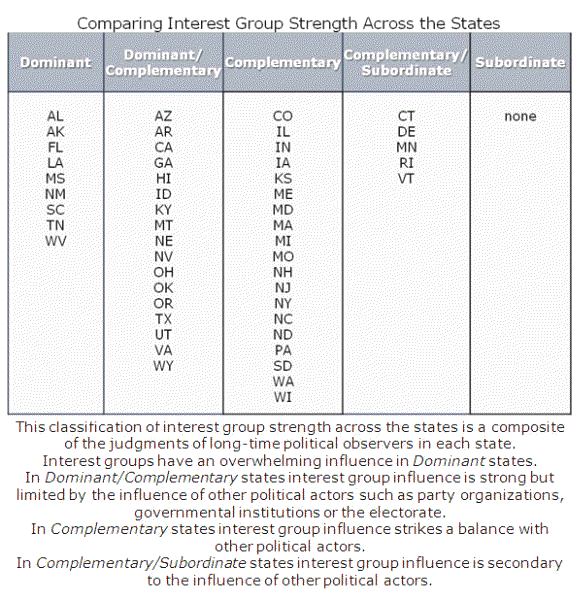
Money: oil and gas industry
Membership: strength in numbers, teachers
Hire former legislators: former members know system and the current members
Distribution across state
wide distribution: strong
narrow or limited distribution: weaker
more diverse economy: more groups, less influence
less diverse economy: few dominant groups, more influence
weak two-party competition: strong groups
strong two-party system: weak groups
decentralized executive structure: strong groups
iron triangle (legislative committee, executive agency, interest group)
centralized executive structure: weaker groups
Are the states banning abortion truly pro-child or just pro-birth?
How Russian Trolls Helped Keep the Women’s March Out of Lock Step
Political party:
a broadly based coalition that attempts to gain control of the government by winning elections
The principal purpose of political party activity is to gain control of government by winning elections.
A. state parties are independent of national organizations
1. few national offices, many state offices
2. common goals and similar issues, but separate organizations

B. state party ideology
1. competitive vs. noncompetitive states
2. policy-relevant vs. non-policy-relevant states
3. Texas
a. not competitive, Republican dominance
b. not policy relevant: old southern Democrats similar to new Republicans
c. traditional culture, small government, low taxes
The majority of American voters stand somewhere near the middle ground on many issues of American politics.

For much of the 20th century, Democrats were the party of the working class, while Republicans were the party of suburban professionals.
Republicans Democrats
suburbs urban areas
younger older
white minorities
professional class working class
In recent decades, however, politics has changed. Over the past generation, Democrats have won over more college graduates and affluent professionals by listening to them - and then creating a party that reflects their views on many issues. As they’ve grown in numbers, college graduates and affluent professionals have instilled increasingly liberal cultural norms, while gaining the power to nudge the Democratic Party to the left. This group also has a higher voter turnout rate in non-presidential elections, when the turnout rate is lower - sometimes much lower - for other groups.
Partly as a result, large portions of the traditional Democratic working-class
base have defected to the Republicans, and that’s increased over the past
decade. Working-class voters are defined as people without a four-year college
degree. These voters make up a majority of the electorate. And they tend to be
more religious, more outwardly patriotic and more culturally conservative than
college graduates.
Race plays an important role here. Republicans have won more working-class votes partly by appealing to white identity. But working-class American voters span racial groups. They tend to be worried about crime and political correctness, however they define it. They have mixed feelings about immigration and abortion laws. They favor many progressive positions on economic policy. They are skeptical of experts. Most believe in God and in a strong America.
Democrats often lament that so many working-class Americans vote against their own economic interests, by supporting Republicans who try to cut health care programs, school funding and more. But working-class conservatives are hardly the only voters who prioritize issues other than their financial situation. College graduates do, too. Pocketbook issues aren’t the only reasonable issues to decide a person’s vote. Other subjects, like climate change, civil rights, religious rights, abortion, immigration, crime, education and Covid-19, are important, too. Sometimes people vote based less on their income and more on their cultural attitudes. Sometimes, these attitudes are related to specific matters of policy, like immigration or abortion. Other times, they involve more personal subjects, like religion or patriotism. The class inversion of American politics is real and, at least in the near future, both parties will struggle to win back or keep working-class voters.
 |
Discover which typology group you fit into.
|
What’s a realignment? It’s a lasting shift in the partisan allegiance of the country, or at least a large demographic group. Think, for instance, of the rise of FDR’s New Deal coalition, or the realignment of the South from Democrats to Republicans after the enactment of the Civil Rights Act. These are epochal, defining moments in American history. Realignments usually require a subsequent election to confirm the shift, a confirming election, because unique candidates and circumstances can produce major electoral shifts that don’t last.
de-alignment and the declining influence of parties
more independent voters
party outsiders win party nominations
media, not party leaders, weed out candidates
raise $ from individuals and interest groups, not just parties
well-funded candidates have upper hand, not party organizations

continuity between elections
precinct chair: basic level in the party organization in Texas
county chair and executive committee
state chair and executive committee
only during election years
precinct convention: held on primary election day, must vote in primary to attend
select delegates to county or district convention
county or district convention
select delegates to county or district convention
state convention
select national convention delegates
nominate electors for electoral college (presidential election years only)
write party platform
primary elections used in Texas
caucus used in Iowa
Directory of US Political Parties
National and State Political Parties
Does the Red-State/Blue-State Model of US Electoral Politics Still Work?
How the Republican and Democratic Parties Got Their Animal Symbols
The State of the Modern Political Logo
Video: Ronald Reagan’s A Time for Choosing Speech on behalf of Goldwater, 1964 (15:11)
Video: Sen. Barry Goldwater’s Presidential Nomination Acceptance Speech at the Republican Convention, 1964 (11:50)
Video: Confrontations at Chicago’s Democratic Convention, 1968 (4:21)
Video: Clip from VP George HW Bush’s Presidential Nomination Acceptance Speech at the Republican Convention, 1988 (0:25)
Video: TX State Treasurer Ann Richards’ Keynote Address at the Democratic Convention, 1988 (5:15)
It Didn’t Start with Trump: The Decades-Long Saga of How the GOP Went Crazy
Detailed new Times maps show how often Democrats and Republicans live in separate neighborhoods.
Labor? Liberal? Patriot? If America had six political parties, which would be yours?
Are we really facing a second Civil War?
Political Parties Playbook: A Guide for Digitizing Party Operations
[This is by no means a complete list of political parties in the US.]
|
America First Party
American Solidarity Party 824 Whitmer Rd Sligo PA 16255 Phone: 202-854-1112 Email: admin@solidarity-party.org
Being Human Party
Citizens Party Philadelphia
PA
Constitution Party
|
Democratic Socialists Party
Freedom Socialist Party
Jeffersonian Party
Justice Party USA http://www.justicepartyusa.org/ PO Box 193 Washington DC 20006 Phone: 202-365-6786 Email:
paulzeitz.justice@gmail.com
Modern Whig Party 1207 Delaware Ave Buffalo NY 14209 Phone: 202-759-4282 Email:
chair@modernwhig.org
Neo Whig Party
Peace and Freedom Party http://www.peaceandfreedom.org PO Box
24764 Phone: 951-787-0318
|
Populist Party of America
Progressive ProAction Party
Prohibition Party
Workers World Party |
...an organized group of people with at least roughly similar political aims and opinions, and with the goal of influencing public policy by getting its candidates elected to public office
Some theorists state that third/minor parties are not really parties because in a winner-take-all system they know they can never win elections. However, third/minor parties frequently win elections for local and even state-wide offices. Even if they didn’t, their goal is to win elections as demonstrated by their continued selection of and campaigning for nominees.
...a sense of belonging and of solidarity generated through active participation
does not have one over-all formal organization but may include many organized groups (for example, the labor movement, which includes trade unions, political parties, consumer cooperatives and many other organizations)
implies the creation of an entirely new political order and so develops a more or less elaborate, more or less consistent set of ideas which its members must accept BUT a given movement’s ideas, and therefore its goals, may be more or less defined
examples of recent movements:
neoreaction (NRx or Dark Enlightenment) (c 2007): an anti-democratic and reactionary movement that favors a return to older societal constructs and forms of government, including support for monarchism and traditional gender roles, coupled with a libertarian or otherwise conservative approach to economics … a loosely-defined cluster of Internet-based political thinkers with no interest in appealing to a wider audience … an early school of thought in the alt-right
Tea Party (2009): despite its name, conservative movement (mixture of libertarian, populist and conservative activism) with a specific set of goals and objectives (reduction of the US national debt and federal budget deficit by reducing government spending, supports lower taxes, opposes government-sponsored programs), has aligned itself with Republican Party
Coffee Party (2010): despite its name, initially founded as an alternative to the Tea Party movement, grassroots organization with specific goals (cooperation and civility in government and removal of corporate influence from politics … government is not the enemy of the people, but the expression of our collective will, and we must participate in the democratic process in order to address the challenges we face)
Alt-right (new right) (2010): loose movement of people with far-right ideologies who reject mainstream conservatism in the US and whose leaders seek to take their ideas mainstream, mostly an online movement that uses websites, chat boards, social media and memes to spread its message
Occupy Wall Street (2011): movement with no specific centralized platform (against social and economic inequality, greed, corruption and the perceived undue influence of corporations on government particularly from the financial services sector) other than a broad call for change and so attracts a variety of ideological perspectives
Political violence occurs when groups of people have very separate worldviews. Some members of these groups and those who back them really believe they are carrying out legitimate acts of revolution when they engage in illegal activity.
Right-wing militias such as Oath Keepers and Three Percenters, whose Roman numeral III can be seen on patches and flags, are anti-government, pro-guns and currently pro-Trump. Others on the right who share the militias’ anti-government views often signal their beliefs with the Gadsden flag, a yellow banner dating to the American Revolution with a rattlesnake and the phrase Don’t Tread on Me.
Boogaloos, who wear their signature Hawaiian shirts, and Proud Boys, who often wear orange hats, include racists and anti-Semites, though the outright white supremacists tend to keep a lower profile. Some wear Crusader crosses or Germanic pagan imagery that has become popular on the racist and anti-Semitic fringes. Others have adopted an OK hand-gesture as their own. Pepé the Frog, the smirking cartoon amphibian that has become a widely recognized symbol of the alt-right crowd, is a common sight.
You will often see the green-and-white flags of Kekistan, the fictional country that is home to the deity “Kek.” In the
meme-driven culture of the alt-right, a satirical religion has sprouted up around Kek “as a way to troll liberals and self-righteous conservatives,” according to the Southern Poverty Law Center, which tracks hate groups. “He is a god of chaos and darkness, with the head of a frog, the source of their mimetic ‘magic,’ to whom the alt-right and Donald Trump owe their success.” The skull-like symbol of the Punisher, a crime-fighting Marvel comic book antihero, is also a common sight. It has become a popular emblem on the far right in recent years and is sometimes used by police officers to signal one another without having to wear badges.
The QAnon conspiracy theory falsely claims that there is a cabal of Democrats, deep-state bureaucrats and international financiers who use their power to rape and kill children, and that Donald Trump was elected to vanquish them. The canard is convoluted and confusing, but its iconography is clear and plentiful: shirts with the letter Q or slogans like Trust the Plan; signs saying Save the Children; and flags with the abbreviation WWG1WGA, which stands for Where We Go One, We Go All.
Occupy Wall Street (OWS) vs The Tea Party
The Tea Party vs. Occupy Wall Street
What You Need To Know About The Alt-Right Movement
Geeks for Monarchy: The Rise of the Neoreactionaries
Jan. 6 Was Just the Beginning for the Proud Boys
How ‘Stop the Steal’ Captured the American Right
Two Americas Index: Democracy deniers

Who participates in politics is an important issue. Those who participate are likely to have more political influence than those who do not. Higher education is the single most important factor in producing a high degree of participation. Older persons and men are also likely to be active. Blacks participate more than whites of equal socioeconomic status.
Although voter turnout has decreased over the past twenty years, it seems that other forms of participation, such as writing letters to public officials and engaging in demonstrations, have increased. There are many ways in which Americans can participate in politics-ranging from voting, which a majority do with some regularity, to belonging to a political club or organization, which only a few do. In an elaborate analysis of the ways people participate, Verba and Nie discovered six different kinds of citizens.
Inactives participate little if at all (22%).
Parochial participants neither vote nor engage in campaigns or community activity, but they do contact officials about specific, often personal, problems (4%).
Communalists engage in community activities of a nonpartisan nature (20%).
Voting specialists regularly vote but do little else (21%).
Campaigners vote and also participate in conflictual political activities, such as campaigns (15%).
Complete activists participate in all forms of political activity (11%).
Americans are less likely to vote than are Europeans. The reasons for this difference are complex. First, the US has an almost bewildering number of elective offices, an estimated 521,000 positions. Voters' enthusiasm for elections is surely deflated by the sheer volume of names with which they must familiarize themselves. In Europe, in contrast, each voter generally is confronted with only one or two offices to fill per election, so that electoral decisions do not impose a burden on the voter. Even in Europe, however, voter apathy increases with the number of elections. Too much democracy, in terms of either selecting government offices or making policy, is exhausting.
A second explanation for the poor turnout rate involves the mechanics of
voting procedures. It is common in other countries for voting to be
compulsory by law and for registration to be carried out automatically by the
government. Mandatory voting would probably fail to survive a constitutional
challenge in this country on First Amendment grounds. Just as people have a
right not to speak (like refusing to salute the flag), it would seem to
follow that they have a right to refrain from voting as well. Simplifying registration is a different matter. Republicans in particular have
tended to resist any easing of registration standards. Even during the 2020
coronavirus pandemic, many office holders fought against making registration and
voting easier, citing concerns about voter fraud even though widespread fraud
has never occurred during modern times.
Simplifying registration is a different matter. Republicans in particular have
tended to resist any easing of registration standards. Even during the 2020
coronavirus pandemic, many office holders fought against making registration and
voting easier, citing concerns about voter fraud even though widespread fraud
has never occurred during modern times.
Over the past decade
civil rights advocates have witnessed and litigated against systematic campaigns
to impede voters at every step of the electoral process. In 2011, 38 states
introduced legislation to constrain and obstruct universal suffrage. Although
state officials claim that voter ID laws and related constraints are necessary
to prevent voter fraud, one of the most
comprehensive studies on the subject
found only 31 individual cases of voter fraud out of 1 billion votes cast since
the year 2000. The state campaigns to impede universal voter participation seem
to reflect a fear and resentment of multiethnic democratic participation as
voters of color are strategically targeted for discrimination and intimidation.
A
federal court struck down North Carolina’s voter ID law,
concluding that its primary purpose wasn’t to stop voter fraud, but rather to
disenfranchise minority voters.
The weakness of political parties must also be considered. Unlike in the past, parties today lack the patronage and welfare incentives to mobilize voting blocs. Moreover, the impact of progressive reforms, such as the Australian ballot and stricter registration requirements for voting, have contributed to the loss of party influence over the electorate.
All these factors combine to explain why people do not vote in large numbers in the US. Yet it is equally important to comprehend the other side of the issue, namely, the factors that lead people to vote. Research underscores the significance of personal characteristics in motivating a person's decision to participate on election day. Education is the most critical variable. As their educational level increases, individuals develop a stronger sense of civic duty and a greater interest in, and knowledge of, politics. But education alone is not a sufficient explanation, since voting rates have continued to decline despite the proliferation of college degrees in recent decades. Another characteristic that correlates with voting is age; older voters are more likely to participate. But here again, overall voting rates have diminished while the population has aged. Something other than personal characteristics therefore seem to play a role in election turnout: the characteristics of the election itself. Most recent elections have presented voters with uninspiring candidates who failed to stimulate interest or excitement. The lack of a realigning issue has made politics boring. However, turnout reaches notable peaks in certain elections, as in 1964 (a sharp ideological choice between candidates) and 1992 (an economy in recession and the charismatic candidate H. Ross Perot). Voters participate when aroused to do so.
Considering how few tangible rewards participation produces, it is not surprising that over 40% of Americans either do not participate at all or limit their participation to voting. Compared to citizens of other democracies, Americans vote less but engage more in other forms of activity. Despite the comments above, the number of Americans who voted in the 2020 November election was an eye-opening: 66.7% of the voting-eligible population. Whether or not that was an exception or the beginning of a new trend in voter turnout remains to be seen.
How to Participate in Politics
Video: The Impact of Protests on Political Change (3:39)
A. regional patterns
1. northern and middle states: higher
2. western and southern states: lower
3. link turnout to political culture
B. calculating turnout
1. voting age population (VAP): all adults over 18
2. registered voters: citizens registered to vote
3. turnout based on registered voters higher than turnout based on VAP
Voting is the principal means of political participation for most Texans.
Years of formal schooling is the single best socioeconomic predictor of the likelihood of an individual to vote.
The primary source of campaign news in the US is television.
In a pivotal state (a large, populous state with many electoral votes that a candidate must win to be elected), presidential candidates are almost forced to rely on advertising.
Candidates try to sell themselves and their ideas on television since it is the surest means of reaching the largest number of people.
In an effort to affect large numbers of voters, candidates often rely on personal attacks on opponents ... negative campaigning. We complain about negative campaigning, but it works!
Texans are most likely to learn political information about candidates from advertising materials prepared by the candidates.

A. ideologue: can articulate a personal political ideology and connect it to specific candidate or party positions (12%)
B. group beneficiary: vote based solely on groups they like or groups they dislike (42%)
C. fair / foul weather: vote only when they believe times are very good or very bad (24%)
D. no issue content: votes are totally disconnected from any ideological or issue content but rather are based either on habitually voting for a specific party or person or based on candidate’s personality, appearance or etc.
A. current registration laws
1. citizen: many immigrants in Texas cannot vote
2. 18 years old
3. 30-day registration deadline (longer than most states)
B. historical barriers
1. $1.75 poll tax: a device used in Texas to prevent lower income persons from voting during the 20th century
2. annual registration required
3. white primaries: in one-party state the primary determines winner of general election
4. property requirements for local elections
5. women’s suffrage
 C. unique social factors in Texas that
keep turnout low
C. unique social factors in Texas that
keep turnout low1. higher poverty rates
2. large minority population
3. large immigrant population
4. lower than average educational levels
5. lower than average age
D. lack of two-party competition
1. one-party Democratic from end of Reconstruction until 1970s
2. same case in most former Confederate states
3. reapportionment
E. traditional/individual culture
F. staggered local elections
Vote: The Machinery of Democracy
Projected Congressional Seats by State
Can anything change Americans’ minds about Donald Trump? And what does that say about our basic theory of responsive democracy?
Commonsense Solidarity: How a Working-Class Coalition Can Be Built, and Maintained - A creative new poll asks working-class respondents - defined as people without a bachelor’s degree - to choose between two hypothetical candidates. The candidates are described both personally (their gender, race and job category) and politically (including a sound bite in which they talk about their views). The poll finds that working-class swing voters hold a swirl of progressive and conservative views.
How College Towns Are Decimating the GOP
Beyond Red vs. Blue: The Political Typology

Primary elections are the first elections held in an electoral cycle. Primary elections are voting processes by which voters can indicate their preference for their party's candidate in an upcoming general election. The laws governing primary elections vary from state to state and can vary within states by locality and by political party. Primaries are generally considered partisan or nonpartisan.
Our current primary system has a number of drawbacks. In one-party states (which often have candidates from only one party running), a partisan primary election may be the only election in which voters have a choice. Too, since partisan gerrymandering has resulted in the vast majority of districts being “safe,” partisan primary elections can limit choice even in competitive states. Only 10% of each party’s voters, who tend towards the extremes, show up for partisan primaries, resulting in increasingly extreme candidates making it to the general election. Partisan primary elections disproportionately empower partisan gatekeepers, who largely decide the candidates that receive support and publicity. By the time most voters make their voices heard, the winner has already been decided. Thus, partisan primary elections do a poor job of reflecting the true preferences of the voters in a district.
open: A voter of any political affiliation may vote in the primary of any party. For example, a voter registered as a Democrat can choose to vote in the Republican primary. A voter may only vote in one party’s primary. In many states, voters are not required to choose a political affiliation when they register to vote. States vary in how they administer open primaries for absentee voters. Critics of this type worry that members of the opposing party can “raid” the election process through crossover voting. Considered a partisan primary.
closed: Voters may only vote in the primary of the party they are registered with. For example, a voter registered as a Republican can only vote in a Republican primary. Absentee voters in states that conduct closed primaries are often required to choose a party affiliation on their voter registration form in order to participate in the state’s primary elections. Voters who have declared loyalty to minor parties or are Independent are not permitted to participate. Considered a partisan primary.
semi-closed: Independent voters, or those without a party affiliation, may choose which party’s primary they want to vote in. Those registered with a party may only vote in that party’s primary. For example, a voter registered as a Democrat may only vote in a Democratic primary, while a voter registered as an Independent may choose to vote in a Democratic or Republican primary. Considered a partisan primary.
top-two: All candidates are listed on the same ballot. Voters choose one candidate per office regardless of party affiliation. The top two vote-getters advance to the general election, regardless of their partisan affiliations, Consequently, it is possible for two candidates belonging to the same political party to win in a top-two primary and face off in the general election. Considered a nonpartisan primary.
top-four: All candidates are listed on the same ballot. Voters are allowed to choose one candidate per office regardless of the candidate's party affiliation. The top four vote-getters advance to the general election, regardless of their partisan affiliations. Consequently, it is possible for four candidates belonging to the same political party to win in a top-four primary and face off in the general election. Considered a nonpartisan primary.
blanket: All candidates are listed on the same ballot. Voters are allowed to choose one candidate per office regardless of the candidate's party affiliation. The top vote-getters from each party that is participating in the primary then advance to the general election. Consequently, one candidate for each political party participating in the primary will face off in the general election. Considered a nonpartisan primary.
runoff: An election held if no candidate for a particular office receives the vote necessary to be elected in an election requiring a majority vote.
presidential preference: Presidential candidates are not directly nominated via primary elections but rather are formally nominated at political party conventions. Presidential preference primary elections or caucuses are held in each state to determine how that state's delegation will vote during the nominating convention. A presidential preference primary is an election at which a political party’s voters are given an opportunity to express their preferences for the party’s presidential candidates, for the purpose of determining the allocation of the party’s delegates from that state to the party’s national presidential nominating convention. There are differences in whether the ballot lists candidate or delegate names. The presidential preference primary is a direct vote for a specific candidate. The voter chooses the candidate by name. The second method is more indirect, giving the voter a choice among delegate names rather than candidate names. Delegates voice support for a particular candidate or remain uncommitted. The Democratic Party always uses a proportional method for awarding delegates. The percentage of delegates each candidate is awarded (or the number of undecided delegates) is representative of the number of primary votes for the candidate. For example imagine a state with ten delegates and three candidates. If 60% of the people supported candidate X, 20% supported candidate Y, and 20% supported candidate Z, candidate X would receive six delegates and candidates Y and Z would each receive two delegates. The Republican Party, unlike the Democratic Party, allows each state to decide whether to use the winner-take-all method or the proportional method. In the winner-take-all method the candidate whom the majority of voters supports receives all the delegates for the state.
Although voters across the country cast ballots for their preferred presidential candidate during the presidential primary season, it’s actually the delegates to the national party conventions who select the presidential nominees for each major party. Pledged/bound delegates must vote for a particular presidential candidate at the convention based on the results of the primary or caucus in their state. The requirement to vote for a specific candidate lasts at least through the first round of voting at the convention, but depending on state and party rules, some pledged/bound delegates become free to vote for any candidate on subsequent rounds of voting. Unpledged/unbound/super delegates may support any presidential candidate regardless of the primary or caucus results in their state or local district.
There is a great deal of disagreement on whether pledged/bound delegates could be stopped at convention if they voted contrary to their pledge. Further, under Democratic Party rules “delegates pledged to a specific candidate are encouraged - but not required - to vote for the candidate they had been selected to support.” Republican delegates may be pledged to a candidate by personal statements or even state law but, according to RNC rules, “may cast their vote for anyone at the convention.”
General elections are statewide elections held every two years in even-numbered years on the Tuesday after the first Monday in November. In general elections candidates (usually chosen via a primary election) are elected to office. Major state officials (such as the attorney general, governor, lieutenant governor and comptroller of public accounts) are elected in nonpresidential/midterm election years. General elections occur at local, state and federal levels. In some cases, general elections may occur at irregular times (special elections), such as to elect a replacement for a seat vacated due to death, resignation or removal from office. Other than those things stated in the US Constitution regarding federal elections, states have control over the administration of general elections, including those for federal offices.
Presidential general elections: Although in most states the names of the candidates for president and vice president appear on the ballot, voters are not electing them. Voters are electing a slate of electors, who collectively will comprise the Electoral College and elect the president and vice president.
The Electoral College is a group of electors that formally elects the president and vice president (elector: a person who elects someone else, college: a decision-making group such as the College of Cardinals, which elects the pope). The number of electors from each state is equal to the sum of the state's senators and representatives in the Congress. The District of Columbia received the right to be represented by electors in 1961 with the ratification of the 23d Amendment. Today, the Electoral College has 538 representatives.
The Founding Fathers rejected the idea of direct elections. This was, of course, a time when communication and travel were difficult and there were no national parties. In the first presidential election, George Washington and John Adams were elected president and vice president respectively by the Electoral College. There was no popular vote.
The power to determine the method of choosing electors belongs to the states. Generally, the parties select the slate of electors, who are then chosen by popular vote. The electors assemble in their respective state capitals on the first Monday after the second Wednesday in December. According to the Constitution, the electors may exercise their own discretion in voting, but in practice all the votes in a given state go to the presidential candidate who has received the plurality of the popular vote. The candidate who becomes the President must win at least 270 electoral votes.
Some have proposed replacing the Electoral College with a system of direct elections. Such proposals would require amending the US Constitution. A system of direct elections would not only reduce the power of the two major political parties, but would also reduce the importance of the states in the electoral process.
The Cost of Ruling - Voters tend to tire of national leaders the longer they’re in power. Often they begin to have higher and higher disapproval ratings, even though national conditions may be quite favorable. Two-term US presidents are even rarely succeeded by a president of the same party. Although there are exceptions, the cost of ruling is a remarkably consistent pattern across democracies.
drawing legislative districts
reapportionment: the process of distributing the 435 US House seats among the 50 states based on changes in population. It is the Constitutional basis for conducting the decennial census.
redistricting: happens after reapportionment, so that each district has roughly the same number of people. Once a state finds out how many House seats it will have for the next 10 years, it redraws the district lines for its seats so that each House district in the state represents the same number of people. The Census tells a state where its residents are located within the state. Based on the results, the state then redraws not only the district lines for its US House seats but also for state legislative seats, state boards and commissions, judicial districts, local officials - the district for any elected office that is not statewide - so that all electoral districts represent an equal number of people.
There is no universal process for drawing district maps, so states use different methods. 17 states currently give some form of redistricting commission responsibility over the map-drawing process. Commissions may be independent, bipartisan, advisory or act only as a backup. 33 states currently assign redistricting to their legislators. Unfortunately, with partisan legislators drawing their own boundaries, there is ample room for political bias.
When redistricting, state legislatures or redistricting commissions are provided certain criteria with which to draw the lines. These criteria are intended to make the districts easy to identify and understand, and to ensure fairness and consistency. All states must comply with the federal constitutional requirements related to population and anti-discrimination. All districts must be as nearly equal in population as practicable. The Voting Rights Act of 1965 prohibits plans that intentionally or inadvertently discriminate on the basis of race, which could dilute the minority vote.
In addition to these mandatory standards set out by the US Constitution and the Voting Rights Act, states are allowed to adopt their own redistricting criteria or principles for drawing the plans. These may be found in state constitutions or statutes or be adopted by a legislature, chamber or committee, or by a court when the legislative process fails. These traditional districting principles have been adopted by many states:
compactness: having the minimum distance between all the parts of a constituency (a circle, square or hexagon)
contiguity: all parts of a district being connected at some point with the rest of the district
preservation of political subdivisions: not crossing county, city or town boundaries when drawing districts
preservation of communities of interest: geographical areas, such as neighborhoods of a city or regions of a state, where the residents have common political interests that do not necessarily coincide with the boundaries of a political subdivision, such as a city or county
preservation of cores of prior districts: maintaining districts as previously drawn, to the extent possible, leading to continuity of representation
avoiding pairing incumbents: avoiding districts that would create contests between incumbents
prohibition on favoring or disfavoring an incumbent, candidate or party: the prohibition in a given state may be broader, covering any person or group, or it may be limited to intentionally or unduly favoring a person or group
prohibition on using partisan data: line drawers, whether commissioners, nonpartisan staff or legislators, are prohibited from using incumbent residences, election results, party registration or other socio-economic data as an input when redrawing districts
competitiveness: districts having relatively even partisan balance, making competition between the two major parties more intense to avoid the creation of “safe” districts for a particular party
proportionality: the statewide proportion of districts whose voters (based on statewide state and federal partisan general election results durin
g the last ten years) favor each political party correspond closely to the statewide preferences of the voters
malapportionment: the creation of electoral districts with unequal population. For example, if one district has 10,000 voters and another has 100,000 voters, voters in the former district have ten times the influence, per person, over the governing body. Sometimes malapportionment is built into the system. For example, the US Constitution gives every state 2 US Senators even though, for example, California has 70 times the population of Wyoming, making California residents vastly underrepresented.
Baker vs. Carr (1962): The 14th Amendment prohibits substantial disparities or malapportionment in total population between electoral districts in the same districting plan … the one- person, one-vote principle.
Reynolds vs. Sims (1964): Under Baker, the electoral districts of state legislative chambers must be roughly equal in population.
Voting Rights Act: Passed at the height of the Civil Rights Movement in 1965, the VRA prevents the systemic and widespread voter discrimination experienced by people of color. The VRA has been used to block voter suppression laws such as demands for voter identification, voter registration purges and making voter registration harder. The process of voting involves not only casting a vote. It also includes rules and processes that determine who is eligible, how to register, how to vote, when polls are open and whether people are put in districts that give them a fair chance of electing their candidate of choice. Section 2 of the VRA protects voters from discrimination based on race, color or membership in a language minority group in all these election procedures.
However, the Supreme Court struck down key provisions of the VRA in Shelby v. Holder (2013) and Brnovich v. Democratic National Committee (2021). These decisions struck down sections 2 and 5 of the VRA, allowing states with a history of racially discriminatory maps and voting rules to implement new voting laws and maps without federal approval, resulting in new discriminatory practices and restrictive voting laws across the country. How effectively the VRA will be able to protect voters of color going into the future is now in doubt.
12/2023 update: The US Court of Appeals for the Eighth Circuit found that only the federal government could bring a legal challenge under Section 2 of the VRA, a crucial part of the law that prohibits election or voting practices that discriminate against Americans based on race, effectively barring private citizens and civil rights groups from filing lawsuits.
structural bias: the institutional patterns and practices that confer advantage to some and disadvantage to others based on identity. The US Constitution and constitutional law regulate the workings of government and supply the rules of the political game. Whether by design or by accident, these rules sometimes tilt the playing field for or against certain political groups - not just episodically, based on who holds power at a given moment, but systematically over time - in terms of electoral outcomes or policy objectives.
single-member district system: the most common US electoral system. It is used to elect the US House and most state and local legislatures. Under single-member systems, an area is divided into a number of geographically defined voting districts, each represented by a single elected official. Voters can only vote for their district’s representative, with the highest vote-getter winning election. Single-member districts can provide voters with one easily identifiable district representative, can maximize accountability because a single representative can be held responsible and can be re-elected or defeated in the next election, and can ensure geographic representation. However, single-member districts must be redrawn on a regular basis to maintain populations of relatively equal size. They are also usually artificial geographic entities whose boundaries don’t delineate clearly identifiable communities, and as a consequence, have no particular relevance to citizens. Because of their winner-take-all nature, single-member districts tend to over-represent the majority party and under-represent other parties. This can lead to bias.
urban-rural polarization: Because Democrats are increasingly concentrated in densely populated cities, their candidates win by overwhelming majorities in large cities but often lose by relatively small margins elsewhere. They often win a greater share of votes than their share of seats, especially in the states of the Midwest, where it is commonplace for the Democrats to win statewide elections without coming anywhere near a majority in the state legislature or the House delegation. This leads to political underrepresentation of people living in cities.
wasted votes: Single-member districts mean that a vote cast for a losing candidate will not be represented. Similarly, a vote cast for a candidate over the threshold needed to win is electorally useless. Both of these votes are wasted votes. Democrats cast more wasted votes than Republicans due to an imbalance in how party members are distributed among districts. This imbalance is a result of both natural sorting and political gerrymandering.
natural sorting: describes how members of the two parties are distributed across the country. Democrats are heavily concentrated in cities and urban areas. Republicans tend to be scattered among rural, exurban and suburban districts. There are more districts with very high concentrations of Democratic voters than there are districts with very high concentrations of Republican voters. This Democratic density makes it easy to win individual seats but creates lots of wasted votes. The end result is that voters are misrepresented in their government.
misrepresentation: In red states, Republicans garnered 56% of the vote but 74.6% of representation. In blue states, Democrats won 60.3% of the vote but 69.1% of representation (seat bonus bias: the gap between each party’s share of the national popular vote and their share of seats). In the House, Democrats over-represent blue states by 19 seats, whereas Republicans over-represent red states by 40 seats. For individual states, misrepresentation is even larger. The level of misrepresentation is 20% or greater in 23 states - almost half the country - and over 30% in 12 states. Misrepresentation can lead to social and economic policy distortions, feed distrust and drive discontent in government. The edge provided by this misrepresentation gives the majority party disproportionate power that is particularly destabilizing and dangerous in an era of heightened polarization and partisanship.
gerrymandering: the practice of drawing the boundaries of electoral districts in a way that gives one political party an unfair advantage over its rivals (political or partisan gerrymandering) or that dilutes the voting power of members of ethnic or linguistic minority groups (racial gerrymandering), while ignoring voter preferences. Gerrymandering is nearly as old as the US (1780s) but it has changed dramatically since the founding. Where politicians once had to pick from a few maps drawn by hand, they now can create and pick from thousands of computer-generated maps, using tactics called packing and cracking. Packing is drawing districts to heavily over-represent the opposition party, wasting as many votes as possible over the winning threshold. Cracking is the opposite: diluting the opposition’s voters into districts so they cannot reach the threshold. Most statewide gerrymanders are a combination of packing and cracking.
Done right, redistricting is a chance to create maps that, in the words of John Adams, are an “exact portrait, a miniature” of the people as a whole. A truly representative government would mean that the composition of the officials elected from districts would mirror the political positions of the population. For instance, if the country were 60% Republican, Congress ought to be 60% Republican as well. But sometimes the redistricting process is used to draw maps that manufacture election outcomes that are detached from the preferences of voters. Rather than voters choosing their representatives, gerrymandering empowers politicians to choose their voters. This tends to occur especially when line drawing is left to legislatures and one political party controls the process, as has become increasingly common. When that happens, partisan concerns almost invariably take precedence over all else. Gerrymandering is one reason that only about 10% to 15% of all 435 seats in the US House are competitive, and one of the many reasons that gerrymandering is extremely unpopular with voters.
Electoral districts that are both uncompetitive and skewed in favor of one group produce electoral results are virtually guaranteed and have a real impact on the balance of power in Congress and in many state legislatures. There is no question that such practices are harmful to democracy by creating electoral districts that are deeply unrepresentative, by pre-determining outcomes and by depriving voters of meaningful choices at the polls.
political gerrymandering: the manipulation of electoral districts to favor one party over another. States where one party controls the process often use gerrymandering to maximize their party’s representation. Political gerrymandering characteristically results in a greater number of wasted votes, both for the losing party and for the winning candidate in excess of the number needed to win (an efficiency gap). Political gerrymandering hinders party competition and the resulting increase in safe seats leads to political monopoly and feeds extremism in the majority party. On the state level, political gerrymandering has led to significant partisan bias in maps. For example, in 2018, Democrats in Wisconsin won every statewide office and a majority of the statewide vote but, thanks to gerrymandering, won only 36 of the 99 seats in the state assembly. The widespread practice has led to a number of challenges in the federal courts but no definitive court decisions. The last political gerrymandering case was Rucho v. Common Cause (2019), in which SCOTUS determined that gerrymandering for party advantage could not be challenged in federal court, that “partisan gerrymandering claims present political questions beyond the reach of the federal courts,” and therefore it had no constitutional authority to throw out voting maps for being too partisan.
extreme political gerrymandering: a recent term for creating maps in which candidates from only one ideological wing are elected and use the party’s control of the process to lock in an outsized share of seats for an entire decade. Its goal is to lock in control of all of a state’s electoral districts regardless of its share of voters. In the wake of the 2020 Census, state legislators crafted a number of hyper-partisan and discriminatory gerrymanders. It occurs not in deeply red or deeply blue states but in battleground states like Wisconsin, Michigan, North Carolina and Pennsylvania, that aren’t starkly clustered but that just happened to be controlled by a single party at the time of redistricting. The cities in those states may be fairly to heavily Democratic but they also have a lot of Democrats in suburbs, college towns and rural areas. Given a comparatively even spread of Republicans and Democrats, it matters greatly how new districts are drawn. Extreme political gerrymandering is closely correlated with single-party control of the redistricting process. The lasting and harmful effects of extreme partisan gerrymandering are especially apparent in traditionally purple states, like North Carolina. At a statewide level, North Carolina is a robust democracy with highly contested elections for everything from president to state auditor. But over the last decade, Republicans secured supermajorities in the state legislature, as well as a safe, durable 10–3 advantage in the congressional delegation. Recent studies have found that gerrymandering, pushed to the limit, could exclude the views of half the country from the legislative process, radically reshaping the makeup of Congress and having major implications for the legislation that could be passed.
racial gerrymandering: sorting voters into districts with a predominant focus on race. Previously, voters of color were protected from gerrymandering by the VRA but in the last decade, the Supreme Court struck down key provisions of the VRA in Shelby v. Holder (2013) and Brnovich v. Democratic National Committee (2021). These decisions struck down sections 2 and 5 of the VRA, allowing states with a history of racially discriminatory maps and voting rules to implement new voting laws and maps without federal approval, resulting in new discriminatory practices and restrictive voting laws across the country. The 2021 redistricting cycle was the first one without the full protections of the VRA and many states took advantage of this to implement racially gerrymandered maps.
A state may not use race as the predominant factor in assigning voters to districts in any federal, state or local electoral maps unless it has a compelling reason to do so. If the map drawers do use race without any compelling reason, then the relevant districts are deemed racially gerrymandered. However, federal law establishes that to combat racial gerrymandering and to ensure compliance with the VRA, states may create majority-minority electoral districts.
majority-minority districts: electoral districts in which the majority of the constituents in the district are racial or ethnic minorities. The creation of such districts can avoid racial vote dilution by preventing the submergence of minority voters into the majority, which can deny minority voters the opportunity to elect a candidate of their choice. But the establishment of majority-minority districts can result in packing, which occurs when a constituency or voting group is placed within a single district, thereby minimizing its influence in other districts. In 2022, there were 136 majority-minority districts in the US House (31% of seats) across 27 states.
[Note: In Rucho v. Common Cause (2019), the Supreme Court said that only racial gerrymandering, but not political gerrymandering, may be challenged in federal court. However, since Black voters overwhelmingly favor Democrats, it may be difficult to distinguish the roles of race and partisanship in drawing electoral maps. That may make it possibly for states to defend racially discriminatory maps on grounds that they were permissibly discriminating against Democrats rather than impermissibly discriminating against voters of color.]
Atlas of US Presidential Elections
Frontline Government / Elections / Politics
Don’t blame the electoral college.
Federalist #68 (Alexander Hamilton): explains the mode of electing the President
Advantage, GOP: Why Democrats have to win large majorities in order to govern while Republicans don’t need majorities at all
What does it mean if Republicans won’t debate?
A Breathtaking Contempt for the People of Wisconsin
American Democracy Was Never Designed to Be Democratic
The roots of today's authoritarianism come from a 19th century Supreme Court ruling.
voter registration: All states except North Dakota require voters to register before voting in an election. Most states allow voter registration by mail. Dates, residency requirements and other details vary by state.
election day in-person voting: Voting online is not yet allowed in the US. Voters who vote on election day must do so in person. Every state (and some localities) has its own hours and required locations (polling places) for voting, and the type of identification a voter is allowed to bring.
early in-person voting: a system or practice by which votes are cast ahead of election day. Most states allow voters to vote in person during a designated early voting period, without requiring an excuse. In some states, voters may need to request an absentee ballot to be able to vote early. The details vary from state to state.
absentee voting or voting by mail: allows voters to vote before election day by mail or drop box. Although every state has absentee voting, deadlines and rules on who can take part vary. In most states, voters need to request an absentee ballot to vote in each election. In some states, voters may qualify to receive absentee ballots permanently. State laws vary greatly.

1. party column: lists all candidates of a party under the party name
also called Indiana ballot
more straight ticket voting
voting for candidates who are all from the same party
2. office block / office group: lists all candidates for an office under the office
also called Massachusetts ballot
more split ticket voting
voting for candidates of different parties for various offices in the same election
3. hybrid
B. access
1. independent candidate: petition signed by 1% of number of voters in last governor election
2. petition signers must be registered voters who did not vote in a primary
3. write-in candidates: must declare candidacy for votes to count
C. minor parties
1. between 5% and 19% of vote for statewide office
2. must hold nominating conventions, but not primary elections
3. if slip below 5% for statewide office, lose ballot status
A. old system
1. local campaigns, limited statewide media
2. tell each county what they want to hear, tailor message to each venue
B. new system
1. mass media, same message
2. speak in sound bites
3. campaign ads
feel good spots: associate the candidate with good times (family eating together, sun coming up), good times for this state or country are ahead with this candidate in office
sainthood: present candidate with his family, ideal father, little league coach, creating the perfect candidate
good old boy: Voters identify with the candidate as being one of them. Create a link between candidate and average people. One version is to have average citizens talking in campaign ads about the candidate, not famous people, politicians or celebrities. Other version is when you make candidate seem a little bit more common, to identify them as someone like them, someone who really cares about people.
NOOTs (No One's Opposed To This): The candidate takes a courageous stand on an issue (broad not detailed because that's when you start getting opposition). Looks into the camera and tells us he's against crime, in favor of making schools better. (Nobody is against these things.)
basher spots: negative campaigning
4. wave election: the president’s party suffers big losses, major surprises are possible, often happens in midterm general elections
1. sell candidate as a product, package the candidate
2. image and message, not the issues

D. role of money
1. Any citizen can contribute to a campaign except those with federal government contracts.
2. Foreigners with no permanent US residency are prohibited from contributing to any campaign.
3. Cash contributions over $100 are prohibited, no matter what their origin.
4. No candidate can accept an anonymous contribution that is more than $50.
5. Corporations, labor unions, national banks and federally chartered corporations are prohibited from contributing to federal campaigns.
6. PACs operated by foreign-owned corporations may contribute as long as Americans are the only contributors to the PAC.
7. Minors are prohibited from contributing to federal candidates and committees of political parties.
1. political action committee: common term for a committee set up to raise and spend money to elect and defeat candidates
2. most PACs represent ideological, business or labor interests
3. can’t buy an election
4. can buy access
5. late train financing: post election fund-raising especially if PAC supported loser
Video: First Televised Presidential Debate, VP Richard Nixon and Senator John Kennedy, 1960 (16:22) [This clip shows just the opening statements of the two candidates.]
Video: Presidential Debate, Pres. Gerald Ford and Gov. Jimmy Carter, 1976 (6:41) [This clip shows just the opening statements of the two candidates.]
Video: Presidential Debate, Pres. Ronald Reagan and Sen. Walter Mondale, 1984 (1:12) [This clip shows just one exchange between the two candidates.]
Video: Vice Presidential Debate, VP George HW Bush and Rep. Geraldine Ferraro, 1984 (4:04) [This clip shows just one exchange between the two candidates.]
Video: Vice Presidential Debate, Sen. Dan Quayle and Sen. Lloyd Bentsen, 1988 (1:24) [This clip shows just one exchange between the two candidates.]
Video: VP Al Gore’s Concession Speech, 2000 (6:45)
Video: Vote for Me: Politics in America (CNAM, 1996): Vote for Me is a series that travels all over America visiting with people who are involved in politics. The saga of Maggie Lauterer, folksinger - turned TV reporter - turned congressional candidate, is especially interesting as Lauterer learns what she has to do to try to get a majority of her district to vote for her. From the smallest local precincts to the White House, the series explores what it really takes to run for public office in the US and ends up being a warm, understanding and surprisingly uplifting view of American democracy. I’m only posting a couple of episodes but if you’re interested in seeing the entire series, you can probably find the other episodes online. [You can probably also find better recordings than mine online but it may cost you money to watch them.]
Vote for Me Part I (1:51:41)
Vote for Me Part II (1:51:46)
Video: POV: A Perfect Candidate (PBS, 1996, 1:45:39): In 1994 former Marine Oliver North emerged from the Iran-Contra scandal to run for the US Senate. In the hotly contested race between North and incumbent Virginia Senator Chuck Robb the filmmakers were granted astonishing access to the back room games played by the candidates, their handlers and the press. Horrifying and hilarious, the film is a twisted journey into American politics.. It’s a revealing, chilling and darkly funny look into the modern American political process. [The recording I have here is 25-years-old and a little rough in spots, mainly the first few minutes of the show. You can very occasionally find it online so I will continue to look for a better recording.]
F. presidential transition
What does it take to transition the most powerful office in the world? Presidential transitions are big, complicated and dangerous. The peaceful, orderly transition of executive power from one leader to another is an American practice. When President George Washington first transferred power to his successor, John Adams, in 1796, it was a radical idea, unprecedented in world history. Over the next two centuries (until the 2020 election), the practice has continued unbroken by the shadow of war, the stain of scandal or the wake of sudden tragedy, and remains a signature achievement of our constitution.
Super Tuesday Results (03/02/2016 - 3:47): A look at voting results and analysis from Super Tuesday, with Republican Candidate Donald Trump and Democratic Candidate Hillary Clinton winning the most states.
Contested Convention Scenarios (02/25/2016 - 1:50): A look at the rules and possible scenarios if there is a contested GOP convention, including backroom deals and delegates trading favors.
Podcast: How the Media Projects the Winner of an Election (32:55)
Center for Presidential Transition
The Most Important Takeover of Any Organization in History
A Short History of Awkward Presidential Transitions
Perspective on Presidential Transitions
... to candidate or candidate committee
... to national party committee
... to PAC or other political committee
... a total amount
Time Period
per primary election and
per general electionper calendar year
per calendar year
per calendar year
Individual can give ...
(indexed for inflation)$2,000
limits higher for candidates facing wealthy opponents financing their own elections
$25,000
per party committeelimits higher to candidates facing wealthy opponents financing their own elections
$10,000
per each state or local party committee
$5,000
per each PAC or other political committeelimits higher to candidates facing wealthy opponents financing their own elections
$95,000 per two year election cycle as follows:
$37,500
per cycle to candidates
$57,500
per cycle to all national party committees and PAC
($20,000 to $57,500
to all national party committees and maximum $37,500 to PACs)Multi-Candidate Committee can give ...
(committee with over 50 contributors, registered for a minimum of 6 months and (with exception of state party committees) has made contributions to 5 or more federal candidates)
$5,000
$15,000
$5,000
No limit
Other Political Committees can give ...
$1,000
$20,000
$5,000
No limit
George Santos Reveals One Truth: It’s Easy to Abuse Campaign Finance Laws: The Federal Election Commission does not have the power to look in bank accounts and must take campaign finance disclosure reports at face value.
Campaign Finance Reform: A Libertarian Primer
WhoPaidThem.com: a game about political money
History of Campaign Commercials
Annenberg Political Fact Check
Cost of Voting in the American States
A complete list of candidates as well as all voting rules and regulations - and probably a list of polling places - is at www.sos.state.tx.us.
|
|


 ... the collected attitudes of citizens on a given issue or question.